
 Heating Solutions
 Solar Energy
I have been in the solar industry for well over a decade, and I still hear the same reaction from homeowners the moment they open their first quote: That is how much? The sticker shock is real. And in a lot of ways, it is understandable. You have seen headlines saying solar is cheaper than ever. You have read that the cost of a solar panel has dropped by more than 90% since 2010. So when someone hands you a proposal for $28,000, something feels off.
Here is the thing: those headlines are true. Solar panels, as a manufactured product, are genuinely cheap now. A decent 400-watt panel can be purchased wholesale for under $150. But the panel is only one piece of a much larger puzzle, and it is not even the most expensive piece. What you are paying for when you go solar is something far more complex than a box of panels sitting on your roof.
This article is an honest attempt to explain every cost that goes into a solar installation: the obvious ones, the overlooked ones, and the ones that most salespeople never mention. If you want the detailed breakdown of what you’ll pay based on system size, I’d suggest reading through how much does solar energy cost — that article gets into the numbers specifically. Here, we’re talking about the why.
Why Solar Feels Expensive Even Though Panel Prices Have Fallen
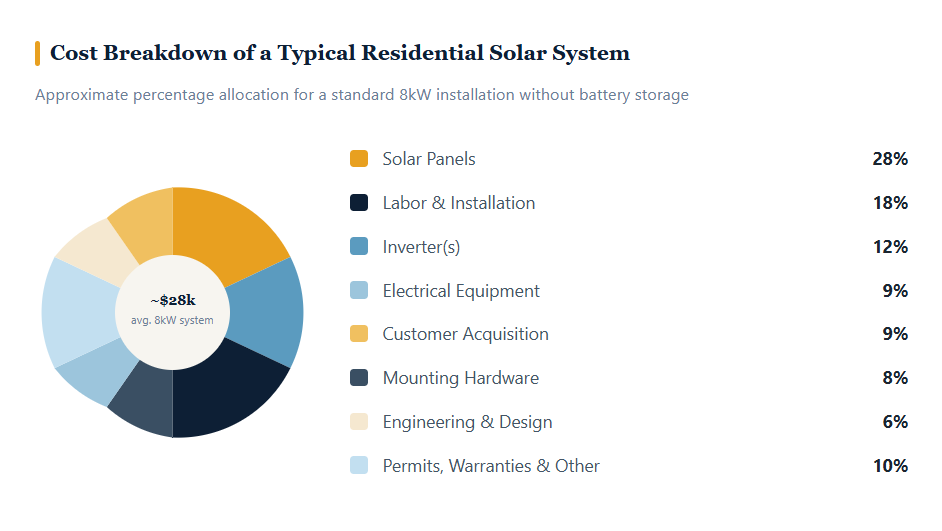
In the early days of the residential solar market, panels accounted for roughly 50 to 60% of a system’s total cost. Today, panels represent closer to 25 to 30% of what a homeowner pays. So even though panels have gotten remarkably cheap, the rest of the system has its own cost structure that does not fall quite as fast.
Think of it like buying a new car. The engine block itself might be cheaper to manufacture than it was 30 years ago. But you are not paying for just an engine block. You are paying for engineering, assembly, safety testing, dealer margins, warranties, extended support, and the fuel system that makes the whole thing run. Solar is the same way.
The second thing to understand is scale. When a homeowner buys solar, they are commissioning a custom-engineered electrical project on their specific home, with their specific roof, in their specific utility territory, under their specific local permitting requirements. That kind of bespoke work carries costs that a factory-produced panel simply does not.
What Are You Actually Paying For When You Buy Solar?
Before we get into the details, here is a clean breakdown of what goes into a typical residential solar quote. Most people assume they are buying panels plus labor. The reality is far more layered.
| Cost Component | What It Covers | Why It Matters |
| Solar Panels | Photovoltaic modules that generate electricity from sunlight | Quality, wattage and degradation rate directly affect long-term output |
| Inverter(s) | Converts DC power from panels into AC power your home uses | Will need replacement during system lifespan; premium models include monitoring and safety features |
| Mounting Hardware | Racking systems, rails, roof attachments and flashings | Must withstand decades of wind, thermal expansion and weather without leaking or corroding |
| Electrical Equipment | Conduit, wiring, junction boxes, breakers, disconnect switches | Must meet NEC code; poor electrical work is the most common cause of system failures and fires |
| Labor | Electricians, roofers, project managers, commissioning techs | Typically 10 to 20% of total project cost; shortcutting labor quality creates safety and performance risks |
| Engineering and Design | Structural load calculations, electrical diagrams, shading analysis | Required by most permitting jurisdictions; poor design leads to suboptimal production and code failures |
| Permits and Inspections | Building, electrical and utility interconnection permits | Varies enormously by jurisdiction; can add weeks to a project timeline and hundreds to thousands in fees |
| Warranties and Service | Panel production guarantees, workmanship warranties, monitoring | A warranty is a legal promise backed by a company that must remain solvent to honor it |
| Customer Acquisition | Marketing, sales commissions, lead generation costs | Often $2,000 to $5,000 or more per job in high-competition markets; embedded in every quote invisibly |
Installation Costs: More Than Just Putting Panels on a Roof
A residential solar installation involves structural engineering to confirm your roof can carry the added weight. It involves electrical design that a licensed engineer often has to stamp and sign. It involves a site survey, permit applications, coordination with your utility for a new interconnection agreement, installation day itself with a crew of two to four workers, a final inspection, and utility sign-off before you are allowed to turn the system on.
In some jurisdictions, the permitting process alone takes six to twelve weeks. That is six to twelve weeks of a company carrying your deposit, managing your paperwork, and paying staff to follow up with bureaucracies that move at their own pace.
Roof complexity matters significantly here too. A simple south-facing gable roof in good condition is straightforward. A multi-faceted hip roof with skylights, chimneys, and aging shingles on a two-story home is a completely different labor equation. Crews working on steep pitches require additional safety equipment and slower, more careful work.
My installer walked me through every step after I got my permit. I had no idea they had submitted eight separate documents to three different agencies. When I asked how long the permit process normally takes, they said three weeks to four months depending on the county. I live in one of the slow counties.
— Homeowner in Sacramento County, CA
Roof complexity matters significantly here too. A simple south-facing gable roof in good condition? Straightforward. A multi-faceted hip roof with skylights, chimneys, and aging shingles on a two-story home? That’s a completely different labor equation. Crews working on steep pitches require additional safety equipment and slower, more careful work. Roof penetrations on complex rooflines require extra care to avoid leaks. And if the roof needs to be replaced before solar goes on — which is common on homes over 15 years old — that’s a separate cost the homeowner often wasn’t expecting.
I got a quote and thought the price was high compared to my neighbor’s. Turns out my roof has four different planes and a 5:12 pitch. My neighbor has a flat single-plane roof. We weren’t comparing apples to apples at all. The installer explained the labor difference in detail and it made complete sense.
— Homeowner in Phoenix, AZ
Why Labor Is One of the Biggest Hidden Expenses
Labor typically accounts for 15–20% of a residential solar project, but it’s the cost that gets the least attention in marketing materials. Partly because it’s not glamorous. Partly because companies would rather talk about panel efficiency ratings than crew wages.
A proper solar installation requires licensed electricians — in most states, C-10 electrical or equivalent. These are skilled tradespeople who earn $35–$75 per hour depending on market and experience level. A typical installation day involves two electricians plus a roofer or general laborer for panel placement. Add project management time, post-installation commissioning (testing and activating the system), follow-up visits for any punch-list items, and ongoing monitoring review, and you’re looking at a meaningful labor investment per project.
Companies that offer dramatically lower labor costs are often making trade-offs. They may be using less experienced subcontractors, skipping commissioning steps, and have less rigorous quality-checking processes. I’ve seen plenty of cheap installations that needed corrective work within the first two years — and by then the original company had often gone out of business or wasn’t returning calls.
There’s also an often-overlooked cost embedded in labor: running a solar business. The contractor who installs your system has to carry general liability insurance, worker’s compensation insurance, a contractor’s license bond, fleet insurance for their trucks, and often errors and omissions insurance. A typical small solar company’s insurance bill can run $80,000–$150,000 per year before a single panel goes on a roof. That cost is, inevitably, baked into every quote.
Why Solar Batteries Add So Much to the Price
Adding a battery to a solar installation is one of the most common sources of sticker shock. A homeowner gets a quote for solar at $24,000. They add a battery, and suddenly it is $38,000. The answer involves several layers.
First, battery chemistry. Modern lithium iron phosphate (LiFePO4) batteries — the kind used in most residential storage systems today — use battery cells that are genuinely expensive to manufacture. The raw materials include lithium, iron, and phosphate compounds processed under precise industrial conditions. A quality 10 kWh battery system contains real manufacturing value, not markup on cheap components.
Second, safety systems. A battery that stores enough energy to power your home during an outage is also a battery that, if it fails catastrophically, could start a fire. Quality residential battery systems include battery management systems (BMS) that actively monitor cell temperature, voltage, and state of charge on a millisecond basis. They include automatic disconnects, venting systems, and thermal management. These aren’t optional features — they’re what separates a safe residential product from an industrial cell bank.
Third, installation complexity. Adding a battery means adding a critical load panel (a separate sub-panel for the circuits you want to power during an outage), a battery inverter or hybrid inverter, additional conduit runs, interconnection between the battery and your solar system, and integration with your utility’s net metering or time-of-use settings. A battery installation on its own is a multi-day electrical project.
Finally, batteries wear out. A typical residential battery warrants 10–15 years of useful life, and will need replacement before your solar panels do. When budgeting for a battery system, you’re not just paying for today’s installation — you’re implicitly agreeing to a future replacement cost that should factor into your decision.
Why Inverters Matter More Than Most Homeowners Realize
The solar inverter is one of the most important — and most frequently underexplained — components in a solar system. In the simplest terms, your panels produce direct current (DC) electricity, and your home runs on alternating current (AC). The inverter is what makes the conversion. Without it, the electricity your panels generate is useless to you.
Where it gets interesting for cost discussions is the range of quality and complexity in inverters. At the budget end, a basic string inverter might cost $1,000–$2,000. Mid-range microinverters (one per panel, installed on the roof) add up to $4,000–$8,000 for a typical system. Premium hybrid inverters capable of managing both solar and battery storage run $2,500–$5,000 for the unit alone. When installers recommend a particular inverter, they’re not just recommending a power converter — they’re recommending a long-term monitoring platform, a warranty relationship, and a system architecture that affects how easy future modifications will be.
Here’s what most homeowners don’t know: inverters typically carry a 10–12 year warranty, but solar systems are designed to last 25–30 years. That means you will very likely replace your inverter at least once during the life of your system. That replacement cost — typically $1,500–$3,500 depending on what you have — is real money that should factor into your long-term thinking.
Premium inverters also include arc-fault circuit interruption (AFCI) protection, which can detect dangerous electrical faults in the wiring before they cause fires. Many jurisdictions now require this. It’s a safety feature with a real cost that a budget inverter might not include.
My installer gave me two quotes: one with microinverters and one with a standard string inverter. The microinverter option was $3,200 more. He explained that if one panel gets shaded, only that panel’s output drops. With a string inverter, the whole system drops. I have three large trees near my roof. I paid the extra $3,200 and never regretted it.
— Homeowner in Portland, OR
Why Financing Can Make Solar Seem Even More Expensive
If you’re comparing an all-cash purchase to a financed solar loan, the financed option will always look more expensive over time — and it genuinely is, once you account for interest. But the picture is more nuanced than that.
Most solar loans today are offered through third-party solar financing companies — names like Mosaic, GreenSky, Sunlight Financial, and others. These lenders charge what’s called a dealer fee (sometimes called a finance fee) to the installer, typically ranging from 20–30% of the loan amount depending on the loan product chosen. Here’s the critical part most homeowners miss: that dealer fee is usually incorporated into the loan amount by the installer. In plain terms, if the cash price of a system is $28,000 and the dealer fee on the loan is 25%, the installer may quote the financed price at $35,000 so that after the fee is deducted, they still receive $28,000.
This is legal, but it’s not always transparent. Some installers tell customers exactly what’s happening. Many don’t. The result is that homeowners sometimes think solar is more expensive than it is when they see a financed quote — or they assume the cash price is the same as the loan principal, which it often isn’t.
The interest cost itself is another layer. A 25-year solar loan at 5.99% on a $35,000 principal will cost over $30,000 in total interest over its life. That doesn’t make it a bad financial decision — it depends entirely on what you’d otherwise be paying for electricity over the same period — but it does mean the sticker price you financed and the true cost of ownership are very different numbers.
Why Quotes From Different Installers Vary So Much
I’ve seen homeowners get three quotes for the same roof and same system size and have them range from $18,000 to $42,000. That gap is jarring, and it raises a legitimate question: is the $18,000 company competent, or is the $42,000 company gouging? In most cases, neither extreme is quite right.
The $18,000 quote might involve budget-tier panels from a manufacturer with a 10-year track record instead of 30. It might use a basic string inverter rather than microinverters. The warranty might be limited to three years of workmanship rather than ten. The crew might be a subcontracted team rather than in-house employees, which affects accountability when problems arise. The company might be operating on very thin margins that won’t survive a warranty claim five years from now.
The $42,000 quote might be genuinely premium — top-tier panels, microinverters, 25-year workmanship warranty, monitoring platform, and a company with a 15-year track record and financial stability to back their promises. Or it might be a company with enormous customer acquisition costs from aggressive advertising, a large commissioned sales force, and margins that reflect sales overhead rather than installation quality.
The honest truth is that most of the variance in solar quotes falls somewhere between legitimate quality differences and organizational cost structures. This is why comparing quotes carefully — component by component, not just total price — is so important.
| What to Compare | Cheap Quote | Premium Quote |
| Panel Brand | Budget-tier or unknown manufacturer | Tier-1 manufacturer with 25+ year track record |
| Panel Warranty | 10 to 12 year product warranty | 25 to 30 year product and performance warranty |
| Inverter Type | Basic string inverter | Microinverters or premium hybrid inverter |
| Workmanship Warranty | 1 to 3 years | 10 to 25 years |
| Installation Crew | Low-cost subcontractors | In-house licensed electricians |
| Monitoring | Optional or basic | Included, app-based, ongoing support |
| Company Track Record | Newer company, limited history | 10+ years operating, verifiable reviews |
| Post-Installation Service | Difficult to reach after sale | Dedicated service team, documented SLAs |
I went with the cheapest quote and deeply regretted it. The crew rushed the job, left a roof penetration improperly flashed, and we had water damage in our attic within the first winter. The company had restructured under a new name by the time I tried to make a warranty claim. I ended up paying $4,200 out of pocket to fix it. I tell every neighbor I have: do not just look at the price.
— Homeowner in Denver, CO
Is Solar Actually Expensive or Simply a Large Upfront Investment?
There’s an important distinction that gets lost in conversations about solar pricing: the difference between price, cost of ownership, and long-term value. These are three entirely different numbers, and confusing them leads to poor decisions in both directions — people who won’t go solar because of sticker shock, and people who go solar expecting guaranteed savings regardless of how they finance it.
The price is what you pay on day one (or what you borrow). The cost of ownership is the total amount you’ll spend over the system’s lifetime, including electricity you no longer buy, loan interest if applicable, inverter replacement, and any maintenance. The long-term value is the combination of energy savings, electricity bill protection, property value increase, and climate impact — less quantifiable, but real.
When homeowners ask “is solar worth it,” they’re often comparing the price to their current monthly bill. But that’s not the right comparison. The right comparison is: what will you spend on electricity over the next 25 years if you don’t go solar, versus what you’ll spend if you do? That reframe changes the picture significantly for most households.
If you want a deeper dive into those numbers specifically, the article on how much does solar energy cost covers the financial side in detail. The point here is simpler: a $30,000 solar system is not the same kind of “expensive” as a $30,000 luxury car. The car depreciates and costs money to run. The solar system appreciates in value relative to rising electricity rates and actively replaces an ongoing expense.
How to Avoid Overpaying for Solar
- Get at least three quotes from different company types: include a national installer, a regional company, and a local independent contractor.
- Compare equipment model-by-model. Ask each installer exactly which panel model and which inverter is being quoted.
- Ask specifically about the workmanship warranty. This is separate from panel and inverter warranties and reflects the installer’s confidence in their own work.
- On a financed quote, ask for the cash price first. Understand whether a dealer fee has been added to the loan principal.
- Check how long the company has been in business under its current name. A company operating continuously for 8 to 10 years is substantially more likely to still be around when you need a warranty claim honored.
- Ask who performs service calls after installation: is it an in-house crew or a third-party service network?
- Do not let urgency push you into a same-day decision. Any installer who says a price is only available today is using a sales tactic, not an honest business practice.
Frequently Asked Questions
Because panels now represent only about 25–30% of your total system cost — down from 50–60% a decade ago. The rest of your quote covers labor, engineering and design, permits and inspections, electrical equipment, inverters, mounting hardware, warranties, monitoring systems, and the installer’s business overhead including insurance, licensing, and customer acquisition. Even though the panel itself is cheap, the rest of the project cost hasn’t fallen at the same pace.
Your quote bundles together a surprisingly large number of things: the panels themselves, an inverter, mounting hardware, all electrical equipment and wiring, skilled labor for installation, a structural and electrical engineering report, local permit fees and inspection costs, a utility interconnection application, a workmanship warranty, a monitoring platform, and often a portion of the company’s sales and marketing costs. Most homeowners only think about the panels — but panels are just one line item among many.
Labor typically accounts for 15–20% of the total project cost, covering licensed electricians, roofers, project managers, and commissioning technicians. Permit fees themselves vary widely by jurisdiction — from a few hundred dollars to several thousand — but the hidden cost is the time involved. In some counties, the permitting process takes six to twelve weeks, during which the installer is paying staff to manage paperwork and follow up with local agencies. On top of that, installers carry significant insurance and licensing costs — often $80,000 to $150,000 per year — which are baked into every quote whether or not they’re itemized.
Several factors drive battery costs up significantly. First, battery chemistry: modern lithium iron phosphate cells require expensive raw materials processed under precise industrial conditions. Second, safety systems: every quality residential battery includes a battery management system that monitors temperature, voltage, and state of charge in real time to prevent dangerous failures. Third, installation complexity: a battery requires a separate critical load panel, a hybrid inverter, additional conduit runs, and integration with your utility’s rate structure — a multi-day electrical project on its own. Finally, batteries wear out in 10–15 years and will need replacing before your panels do.
The inverter converts the DC electricity your panels generate into the AC electricity your home uses. Without it, your solar system produces power you can’t use. Costs range from around $1,000 for a basic string inverter to $4,000–$8,000 for a full microinverter system. Premium models include arc-fault protection, real-time monitoring, and longer warranty terms. The critical thing most homeowners miss: inverters carry a 10–12 year warranty, but solar systems are designed to last 25–30 years. You will almost certainly replace your inverter at least once, at a cost of $1,500–$3,500 — a real expense that should factor into your long-term planning.
Two things happen when you finance solar. First, solar lenders charge installers a dealer fee of 20–30% of the loan amount. Installers typically pass this on by increasing the loan principal — so a $28,000 cash-price system might be quoted at $35,000 for financing, even though the installer still receives $28,000. This is legal, but it is not always disclosed clearly. Second, interest compounds over time. A 25-year loan at 5.99% on a $35,000 principal can cost over $30,000 in total interest. Always ask your installer for the cash price separate from the loan principal so you can see exactly what the financing is adding.
The gap between a cheap quote and a premium quote typically comes down to four things: equipment quality (budget-tier vs. tier-1 panels and inverters), warranty terms (1–3 years workmanship vs. 10–25 years), labor standards (subcontracted crews vs. in-house licensed electricians), and company overhead. A company with aggressive advertising and large sales commissions will quote higher to cover those costs. A dramatically low quote often means something has been cut — and what gets cut most often is warranty depth, equipment quality, and experienced labor.
Get at least three quotes and compare them component by component, not just total price. Look up the specific panel model and inverter model in each quote and check their warranty terms and manufacturer track record. Ask about the workmanship warranty separately from the equipment warranties. On financed quotes, ask to see the cash price so you can identify any dealer fee added to the loan principal. Check how long the company has been in business under its current name — a company that has operated continuously for 8–10 years is a much safer bet for long-term warranty support than a newer entrant.
It is both, and the distinction matters. The sticker price is large — typically $20,000–$50,000 depending on system size and configuration. But unlike most large purchases, a solar system actively generates value over time by replacing electricity you would otherwise buy from your utility. The right comparison is not “is $30,000 a lot of money” but rather “what will I spend on electricity over the next 25 years if I do nothing?” For most households, that number is significantly higher than the cost of going solar.
The most commonly overlooked cost drivers include customer acquisition costs ($2,000–$5,000 or more per job, embedded invisibly in your quote), engineering and design fees required by most permitting authorities, electrical upgrades if your main panel is old or undersized, roof complexity surcharges for steep or multi-faceted roofs, inverter replacement as a mid-life cost most people don’t budget for, and battery replacement around 10–15 years into ownership for those who add storage.
Conclusion: Expensive Does Not Mean Overpriced
When you strip away the marketing language and look at what a solar project actually contains — custom-engineered electrical infrastructure, skilled licensed labor, professional structural and electrical design, local government permitting and inspections, utility coordination, quality components with decades-long warranties, a monitoring platform, and an after-sales support relationship — it starts to make sense why the number is what it is.
Solar is expensive the same way a new roof is expensive, or a kitchen renovation is expensive. You’re commissioning professional trades work on your home that will affect its value and function for decades. The difference is that a new roof only costs you money. A well-designed solar system generates value and pays you back — in reduced electricity bills, in protection against utility rate increases, and in a property that’s worth more to future buyers.
The question worth asking isn’t “why is solar so expensive?” The more useful question is: “Is what I’m being quoted a fair price for what I’m actually receiving?” That requires comparison shopping, equipment literacy, and a clear understanding of what’s included and what’s not.
The homeowners I’ve seen most satisfied with their solar investments over the years are almost never the ones who found the cheapest quote. They’re the ones who understood what they were buying, chose an installer they trusted, and went into the project with realistic expectations about cost, timeline, and long-term performance. That combination — knowledge plus trust plus realistic expectations — is the real value a good solar consultant brings to the table.