
 Heating Solutions
 Solar Energy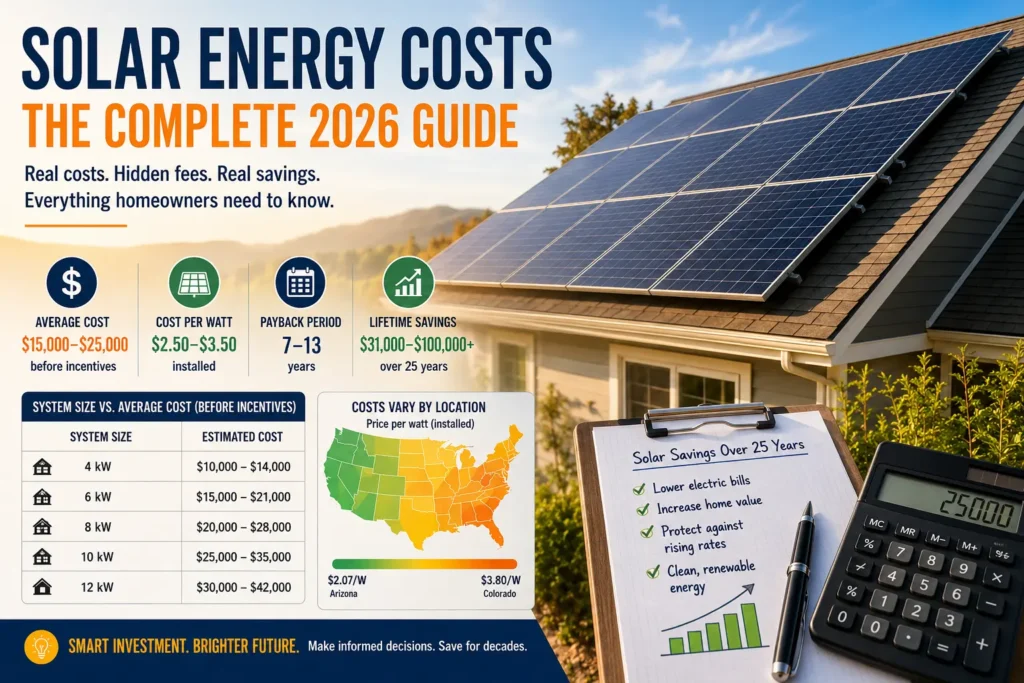
If you’ve ever stood in your backyard squinting at your roof and thought, “Could solar panels actually work here?” — you’re in the right place. The question of how much solar energy costs is one that millions of homeowners search every year, and yet most of the answers they find are either too vague (“it depends!”) or too optimistic (glossing over what you’ll actually pay out of pocket).
This guide cuts through the noise. We’ll look at real installation costs, break down what drives the price up or down, dig into the stuff most companies don’t mention upfront, and show you what the return on investment actually looks like — not in a salesperson’s pitch, but in real numbers you can work with.
The Short Answer: What Does Solar Energy Cost in 2026?
Let’s start with the numbers you came here for.
As of 2026, the average cost of residential solar panels in the U.S. is between $15,000 and $25,000 before incentives. This typically translates to about $2.50 to $3.50 per watt of installed capacity.
If you’re still in the research phase and want to understand what solar energy actually is before committing to numbers, start with our complete solar energy guide.
For a typical American home — one that uses around 10,000–11,000 kWh of electricity per year — you’re generally looking at a system in the 6 to 10 kW range. Here’s how that translates into rough dollar figures before any incentives:
| System Size | Estimated Cost (Before Incentives) |
|---|---|
| 4 kW | $10,000–$14,000 |
| 6 kW | $15,000–$21,000 |
| 8 kW | $20,000–$28,000 |
| 10 kW | $25,000–$35,000 |
| 12 kW | $30,000–$42,000 |
Keep in mind these are ranges, not guarantees. Your actual quote will depend on your roof, your location, the installer you choose, and the equipment they use. We’ll get into all of that shortly.
How Much Does a Solar Energy System Cost? Breaking It Down Component by Component
Here’s something most solar shopping guides skip: the panels themselves are actually a small slice of what you pay.
Solar panels are just 12% of the total cost of a solar panel installation.
So where does the rest go? A full solar installation typically includes:
- Solar panels — The photovoltaic modules that capture sunlight (that 12%)
- Inverter(s) — Converts DC power from panels to AC power your home uses (roughly 10–15%)
- Racking and mounting hardware — The structure that holds panels to your roof (5–10%)
- Electrical wiring and components — Conduit, disconnect switches, wiring (5–10%)
- Labor and installation — The crew who does the actual work (15–25%)
- Permits and inspections — Local government approvals (5–10%)
- Soft costs — Sales, overhead, profit margin for the installer (25–30%)
That last category — soft costs — is where many homeowners are surprised. It’s not nefarious; it’s just the reality of running a business. But it does mean that different installers can quote wildly different prices for the exact same equipment, because their sales and overhead costs vary. This is why getting multiple quotes matters so much. If you want the full picture of what drives that variation — labor, permitting, batteries, inverters, and financing included — we break it down in detail in why is solar energy so expensive.
Understanding what you’re paying for makes the quote process much easier — our guide to how solar panels work explains every component of a system, from cells to inverters, so you know exactly what’s on that itemised installer quote.
The Price Per Watt Metric
When you’re comparing solar quotes, the most useful number is cost per watt ($/W). It lets you compare any system of any size on equal footing.
The solar industry measures costs in dollars per watt ($/W), which allows apples-to-apples comparison regardless of system size. In 2025, national average costs range from $2.50 to $3.50 per watt before incentives. This price includes everything: solar panels, inverters, racking, electrical work, permits, inspections, and installation labor. It does NOT include battery storage.
If a quote comes in at $4.00/W or higher, that’s a signal to ask questions or get another opinion. If it’s below $2.00/W, be cautious about what might be compromised on equipment quality or installation standards.
How Much Does It Cost to Install Solar Energy? Location Matters More Than You Think
Regional variation is significant: costs range from $2.07/W in Arizona to $3.80/W in parts of Colorado.
Why such a gap? Several factors create this geographic spread:
Sunlight and climate — Sunnier states like Arizona, Nevada, and Florida can make do with smaller systems to produce the same energy as cloudy states, which means lower total costs.
Local labor markets — Solar installation is skilled work. In high cost-of-living areas, labor rates are higher.
State-level competition — States with more solar installers have more competitive pricing. Mature markets like California and Arizona have driven installer margins down over years of competition.
Utility rate structures — States with higher electricity rates make solar more financially attractive, which also drives more adoption and more competition.
Permitting complexity — Some counties and municipalities have more complex permitting processes, which adds time and cost.
If you’re in a state with high electricity rates and good sun — think California, Massachusetts, Hawaii, or New York — solar economics are often compelling even if the installation cost is slightly higher. If you’re in a low-rate, low-sun state, the math requires more careful scrutiny.
How Much Does Solar Energy Cost to Install: The Incentive Picture (2026 Update)
This is a critical section, and the information here is genuinely time-sensitive.
In previous years, homeowners could claim a federal tax credit worth 30% of their solar and/or battery expenses. While this consumer-claimed credit expired at the end of 2025, homeowners can still benefit from a business-claimed federal tax credit through third-party owned solar arrangements.
This is a significant shift. The 30% Residential Clean Energy Credit (Section 25D) — which saved homeowners thousands of dollars — is no longer available for systems installed after December 31, 2025. If you’re reading this in 2026, that particular window has closed.
What incentives still exist in 2026?
- State-level tax credits — Many states have their own solar incentive programs. California, New York, Massachusetts, and several others offer meaningful credits or rebates.
- Utility rebates — Some utilities still offer cash-back programs for solar installation.
- Net metering — Where available, this lets you earn credits for excess electricity your system sends back to the grid.
- Solar Renewable Energy Certificates (SRECs) — In some states (New Jersey, Massachusetts, Pennsylvania), you can earn and sell certificates based on your system’s production.
- Property tax exemptions — Many states exempt the added home value from solar from property tax assessments.
The best resource to find current state-level incentives is the DSIRE database (dsireusa.org), which tracks federal, state, and local solar incentives in real time.
Tip: Don’t take a salesperson’s word for what incentives you qualify for. Always verify directly with a tax professional or your state’s energy office.
The Hidden Costs No One Warned Me About (A Real Homeowner’s Story)
“I thought I’d done my homework,” says Marcus, a homeowner in suburban Ohio who installed a 9 kW system in late 2024. “I had three quotes. I understood the price per watt. I knew about the federal tax credit. But there were at least four things I genuinely didn’t see coming.”
Here’s what Marcus and homeowners like him often discover after the sale:
1. The Roof You Forgot About
Solar installers will inspect your roof before installation, but they’re not roofing contractors. The most common hidden costs to check are roof repair or replacement timing, panel removal and reinstallation, electrical panel or service upgrades, inverter and labor coverage gaps, insurance changes, financing fees, and utility interconnection costs.
If your roof is 15 years old with 10 years of life left, you face a real problem: installing panels on a roof you’ll need to replace in a decade means paying to remove and reinstall those panels. That can cost $2,000–$5,000+, and it’s rarely mentioned during the sales process. Marcus needed a partial re-roof before installation — $4,200 that wasn’t in any of his three quotes.
2. The Electrical Panel Upgrade
Older homes often have electrical panels that aren’t compatible with modern solar systems or the load added by EV chargers alongside solar. An electrical panel upgrade runs $1,500–$4,000 and may be required by your local utility before they’ll approve interconnection.
3. The Loan Interest Nobody Totals Up
Many solar installations are financed through solar-specific loans at 5.5–7% interest. The monthly payment sounds manageable, but when you run the total interest paid over a 10–12 year loan, it can add $5,000–$12,000 to your actual system cost. Finance costs hit hard. Consumers increasingly note that the cost of installing solar and the cost of borrowing to do it versus the cost of buying electricity needs more transparent comparison.
4. Inflated Savings Projections
One homeowner recounted: “When I had my solar installed, the companies I got bids from gave me laughable exaggerated cost savings figures. One claimed I would save $100,000 in electricity over 10-15 years. The funny thing is I only spend $2,500–3,000 a year on electricity.”
A simple check: multiply your annual electricity bill by 25 (the assumed system life). That’s the theoretical maximum you could ever save. Any savings projection that exceeds that number is fiction.
5. The “Minimum Monthly Charge” Reality
Even with solar, most utilities charge a minimum monthly service or grid connection fee. This typically ranges from $10–$30/month but can be higher. You’ll probably never fully eliminate your electricity bill — just reduce it dramatically.
6. Monitoring, Maintenance, and Eventual Inverter Replacement
Solar panels themselves are largely maintenance-free and often come with 25-year performance warranties. But inverters typically last 10–15 years. A string inverter replacement costs $1,500–$3,000. Some monitoring systems also charge subscription fees of $5–$20/month.
Marcus’s bottom line: “My actual all-in cost was about $6,000 higher than my quote suggested when I added up the roof work, panel upgrade, and loan interest. It still made financial sense for me — but I wish I’d known going in.”
Solar Energy Cost vs. Long-Term Savings: The ROI Picture
Here’s where solar gets genuinely exciting, even without the federal tax credit.
Solar panels typically offer a 7.1-year average payback period and can generate $31,000 to $100,000 in lifetime savings.
Let’s walk through a realistic example:
Sample Household in Texas:
- Annual electricity usage: 12,000 kWh
- Average electricity rate: $0.14/kWh
- Annual electricity bill: ~$1,680
- System needed: 8 kW
- Installation cost: $22,000 (before incentives)
- State rebate available: $2,000
- Net cost: $20,000
Annual savings from solar: ~$1,400–$1,600 (assuming system covers 85–90% of usage)
Simple payback period: ~13 years
25-year lifetime savings: ~$42,000 (accounting for ~3% annual electricity rate increases)
Net profit over 25 years: ~$22,000
That’s a real return. And that’s without the federal tax credit. With state incentives varying, some homeowners in high-rate states like California or Massachusetts see payback periods as short as 6–8 years.
These numbers illustrate why so many homeowners are interested in solar, but it’s important to remember that savings are never one-size-fits-all. I’ve seen two nearly identical homes produce dramatically different financial outcomes simply because their electricity habits, utility rates, and daytime energy use were different. If you’re wondering what your household could realistically save and whether solar panels can meaningfully reduce your electricity bills, our guide on how much do you save with solar energy breaks down real-world savings scenarios, bill reduction expectations, and the factors that make the biggest difference.
The Home Value Equation
According to a study by Zillow, solar panels increase home values by an average of 4.1%. More recent data from SolarInsure suggests homes with newer solar systems could sell for up to 10% more.
On a $350,000 home, a 4.1% increase represents $14,350 in added value — nearly on par with the system cost in many cases. This means even if you sell your home before recouping costs through electricity savings, you may recoup through the sale price.
Importantly: home value increases tend to be strongest in areas with high electricity rates, strong solar markets, and buyers who understand the value of a home with existing solar.
Solar Financing Options: Paying for Your System
Understanding solar costs also means understanding how you’ll actually pay for them. There are four main pathways:
1. Cash Purchase The simplest and most profitable option if you have the capital. You own the system outright, capture all incentives and savings, and have no interest costs. Typical payback: 7–13 years depending on location.
2. Solar Loan Most common option. You own the system (and thus own the incentives), but pay monthly with interest. After the 30% federal tax credit and state incentives, your out-of-pocket cost drops dramatically — often by 40–60%. A $20,000 system becomes $14,000 or less after incentives, completely changing the affordability equation. With a loan, you still benefit from any remaining incentives.
3. Solar Lease A third-party company owns the panels and installs them on your roof. You pay a fixed monthly lease amount (usually lower than your electricity bill). You don’t own the system, can’t claim tax incentives, and savings are lower — but there’s no upfront cost. Can complicate home sales.
4. Power Purchase Agreement (PPA) Similar to a lease. You pay a per-kWh rate for the electricity the panels produce, often at a discount to your utility rate. Good for people who can’t use tax credits. Also comes with the ownership caveats of a lease.
Which is best? For most homeowners who can qualify for a loan, ownership (cash or loan) beats leasing and PPAs on lifetime savings. But if upfront cost or credit is a barrier, a lease/PPA can still deliver meaningful savings.
How to Get an Accurate Solar Quote: 5 Things to Know Before You Call
Most people get one or two quotes and make a decision. Here’s how to do it better:
1. Get at least three quotes. Solar installation prices vary enormously between companies. Getting multiple bids is the single most effective way to avoid overpaying. EnergySage prices are over 25% lower than the national median price, partly because they help installers decrease sales and marketing costs by connecting them directly with homeowners. Comparison platforms can help you access competitive pricing without the high-pressure sales environment.
2. Ask what the quote includes. Does it include permitting? Utility interconnection fees? Electrical panel upgrades if needed? Roof repair if required? Get it in writing.
3. Understand the equipment tier. Not all panels are equal. Tier 1 manufacturers (like LG, SunPower, Panasonic, REC, Jinko) offer better performance warranties and reliability than budget options. Ask for the specific model numbers and look them up independently.
4. Ask about the inverter. String inverters are cheaper but mean one shaded panel affects your whole system. Microinverters or power optimizers cost more but optimize each panel independently — worth it if you have shade on your roof.
5. Run the math yourself. Take your average monthly electricity bill, multiply by 12 to get annual usage cost, then divide by your system’s projected annual output. Compare that to the loan payment or cash outlay. If the solar payment exceeds your current electricity bill for the first several years of a loan, be cautious.
Commercial Solar: How Much Does a Solar Energy System Cost for Businesses?
In 2025, the average cost for commercial solar panels is just about $2.00 per watt. Commercial solar installations are generally a bit less per watt because the systems are larger, but the total costs will be higher.
For a small business, a 50 kW system might run $100,000 before incentives. For a warehouse or manufacturing facility, systems of 200–500 kW (and larger) are common, with total project costs running $400,000–$1,000,000+.
Commercial solar economics have been boosted by the continued availability of investment tax credits (ITCs) through third-party ownership arrangements, even as the residential credit expired. Businesses can also benefit from accelerated depreciation (MACRS), which significantly improves the financial case for commercial solar.
For commercial buyers, the ROI math often works out faster than residential due to higher electricity consumption, better rate structures, and stronger available incentives.
Is Solar Worth It in 2026? Honest Answer
The honest answer is: it depends on four things.
Your electricity rate — If you pay more than $0.12/kWh, solar is generally worth serious consideration. If you pay $0.07–0.09/kWh (common in parts of the Southeast), the math is harder.
Your sun exposure — South-facing roofs with minimal shade are ideal. East or west-facing roofs still work but produce 10–20% less energy. North-facing roofs in northern climates are rarely ideal.
How long you plan to stay — Solar earns its full financial return over 15–25 years. If you’re planning to move in 3 years, the home value increase may offset this, but shorter-term installations carry more financial risk.
How you’ll pay — Cash purchases yield the best ROI. Loans still work well. Leases and PPAs have lower lifetime returns but lower barriers to entry.
Since 2010, the cost to install solar panels on a home has fallen by roughly 50%. Even without the federal residential tax credit, solar in 2026 is dramatically more affordable than it was a decade ago. For the right home in the right location, it remains one of the most financially sound home improvements available.
Cost is only one side of the equation. Before you commit, our solar advantages and disadvantages guide will help you weigh the full picture — financial, environmental, and practical.
Solar Energy Cost: Quick Reference Summary
| Factor | Typical Range |
|---|---|
| Average system cost (residential) | $15,000–$35,000 |
| Cost per watt (installed) | $2.50–$3.50/W |
| Single solar panel (400W) | $120–$200 |
| Battery storage add-on | $10,000–$15,000+ |
| Commercial solar (per watt) | ~$2.00/W |
| Federal residential tax credit (2026) | Expired |
| Average payback period | 7–13 years |
| Average lifetime savings | $31,000–$100,000 |
| Home value increase | 4–10% |
| Panel lifespan | 25–30 years |
Final Thoughts: What to Do Next
If you’ve made it this far, you now know more about solar energy costs than most people who’ve already installed panels. Here’s what to do with that knowledge:
- Check your electricity bill — Find your average monthly kWh usage. This determines your system size and shapes every financial calculation.
- Research your state’s incentives — Visit dsireusa.org for a current list.
- Get multiple quotes — At least three. Use comparison platforms to get competitive pricing without the pressure.
- Ask the hard questions — Roof condition, electrical panel compatibility, interconnection timeline, loan total cost.
- Run the math conservatively — Assume your savings are 20% less than projected and your costs are 10% more. If it still makes sense, it probably will.
Solar energy is a major financial decision. Done right, it can save you tens of thousands of dollars over the life of your home. Done poorly — with an inflated quote, unexpected hidden costs, or a roof that needed replacing — it can take much longer to break even than you’d hoped. The difference almost always comes down to how well-informed you were going in.
Frequently Asked Questions
The average residential solar system in the U.S. costs between $15,000 and $25,000 before incentives, depending on system size, equipment quality, and installation complexity.
Most homeowners pay between $2.50 and $3.50 per watt installed. This includes panels, inverter, mounting hardware, labor, permits, and installation.
A 6 kW solar system generally costs between $15,000 and $21,000 before incentives, making it one of the most common system sizes for average households.
No. The Residential Clean Energy Credit (Section 25D) expired for residential systems installed after December 31, 2025. However, some state and utility incentives may still be available.
Yes. Many homeowners can still benefit from state rebates, utility incentives, net metering programs, SRECs, and property tax exemptions, depending on location.
Common unexpected costs include:
- Roof repairs or replacement
- Electrical panel upgrades
- Loan interest charges
- Utility interconnection fees
- Inverter replacement after 10–15 years
Most residential systems have a payback period of 7–13 years, depending on electricity rates, sunlight exposure, installation cost, and available incentives.
A well-designed system can generate $31,000 to $100,000 in lifetime electricity savings over 25–30 years.
Yes. Studies suggest solar panels can increase home value by 4–10%, especially in areas with high electricity prices and strong solar demand.
Cash purchases typically provide the highest long-term return because there are no interest costs. Solar loans can still offer strong savings, while leases and PPAs usually provide lower overall financial benefit.
Solar is usually worth considering if you:
- Pay more than $0.12 per kWh for electricity
- Have a roof with good sun exposure
- Plan to stay in your home for several years
- Can secure competitive installation pricing
You should get at least three quotes from licensed installers to compare pricing, equipment quality, warranties, and projected savings.
Disclaimer: Prices, incentives, and tax credit information in this article are based on data available as of 2026 and are intended for general informational purposes only. Solar installation costs vary significantly by location, system size, roof type, equipment, and installer. Incentive programs — including federal, state, and utility rebates — change frequently and may not be available in your area. Always obtain multiple quotes from licensed installers and consult a qualified tax professional before making any financial decisions.
Data sources: EnergySage Marketplace Data (2025), Lawrence Berkeley National Laboratory Tracking the Sun Report (2025), Solar.com Industry Analysis (2026), NREL National Renewable Energy Laboratory, Zillow Home Value Research, U.S. Energy Information Administration (EIA), SolarReviews Market Data (2025).