
 Heating Solutions
 Solar Energy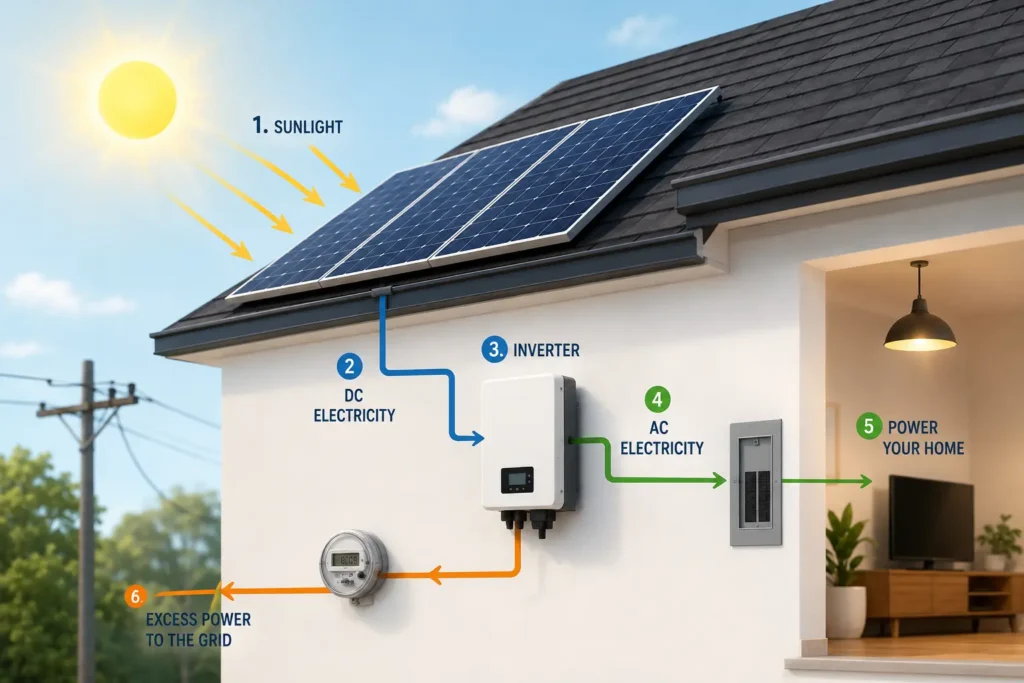
Your panels sit on the roof, the sun comes up, and somehow your kettle boils without touching the electricity meter. But what’s actually happening between those two things? Here’s the full journey, no physics degree required.
What This Guide Covers
If you’re new to solar entirely, start with our complete guide to what solar energy is. This article focuses on one specific question: how does sunlight physically become usable electricity in your home, step by step?
Step 1: Sunlight Hits the Panel
Sunlight arrives as a stream of photons — tiny packets of energy. When they strike a solar panel, one of three things happens: they reflect off, pass straight through, or get absorbed by the silicon cells inside. Only the absorbed photons do anything useful.
One thing that surprises most people: panels don’t need blazing sunshine. Daylight on an overcast day still contains photons. A panel on a cloudy Sydney morning might produce 15-25% of its clear-sky output. It’s still generating.
What most buyers never hear: heat actually hurts performance. Most panels lose 0.3-0.5% of their output for every degree Celsius above 25C. On a 45C summer day, your panel surface can hit 60C, meaning it runs at 85-88% capacity despite brilliant sunshine. A bright, crisp 15C winter day often outperforms a scorching summer one. This is called the temperature coefficient, and it’s why installers leave an air gap beneath panels to keep them cooler.
“My best production months are September and October — bright but not hot. Summer is still good, just not what I expected.” — Marcus T., homeowner, Brisbane
If you live somewhere that regularly hits 35C+, ask your installer specifically about temperature coefficients. Premium panels can have ratings as low as -0.27%/C versus -0.45%/C for standard panels — a meaningful difference over 25 years in Queensland.
Step 2: The Cell Converts Light Into Electricity
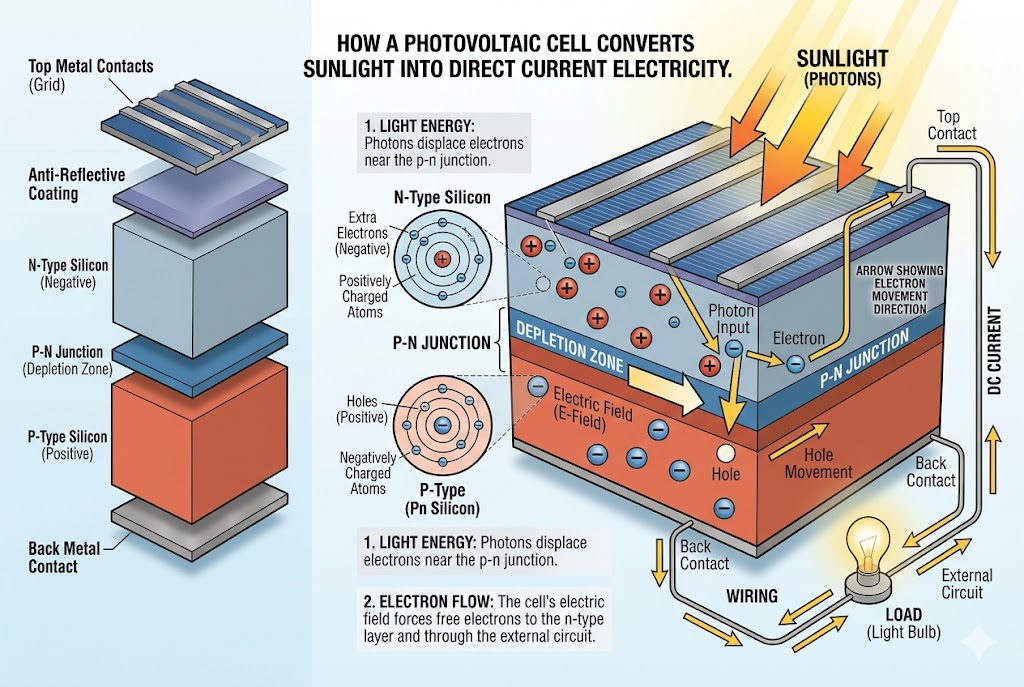
The heart of every solar panel is the photovoltaic (PV) cell, made from silicon. Inside each cell, two silicon layers sit back-to-back: one with extra electrons (n-type), one with spaces where electrons are missing (p-type). Where they meet is called the p-n junction — a built-in electric field acting like a one-way gate.
When a photon hits the cell and knocks an electron loose, that electric field immediately pushes the electron in one direction across a circuit. That directional movement of electrons is electrical current.
More photons, more electrons knocked loose, more current. The cell isn’t storing energy — it’s converting incoming light into outgoing electricity in real time, only while light is present.
Cells are wired together into a panel (typically 60-96 cells per panel), producing 300-450 watts each. Panels are grouped into your array — a typical Australian 6.6kW system has 16-20 panels depending on individual panel wattage.
Step 3: The Inverter Converts DC to AC
Solar cells produce direct current (DC) — electricity flowing steadily in one direction. Your appliances run on alternating current (AC) — electricity that reverses direction 50 times per second. Without an inverter to bridge this gap, your panels can’t power anything in your home.
There are three main types:
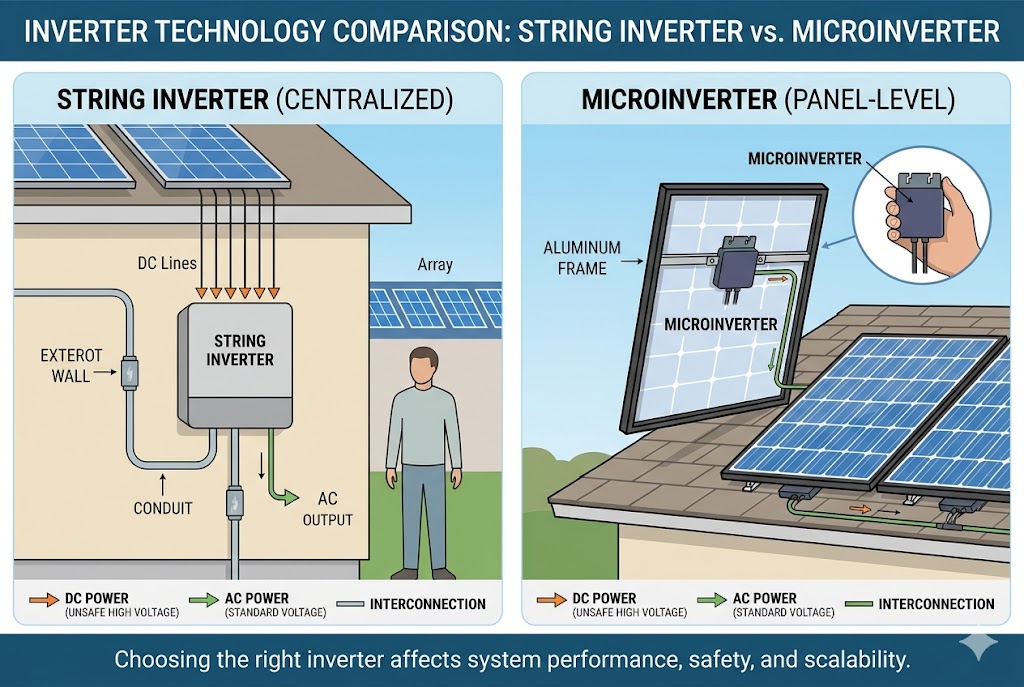
String inverters connect all your panels into one central box mounted on your wall. Lower cost, simpler installation, proven long-term reliability. The catch: if one panel underperforms due to shade or soiling, it pulls the output of every panel in the string down with it. Research shows shading can cause 15-35% output loss across a whole string system, where panel-level electronics would limit the loss to just that one panel.
Microinverters attach individually to each panel. Every panel operates independently — shade on one panel affects only that panel. They cost 20-30% more upfront but perform significantly better on roofs with chimneys, aerials, trees, or multiple orientations.
Power optimisers are the middle ground: each panel gets its own optimiser device, but a single central inverter still handles the DC-to-AC conversion. They deliver most of the shading resilience of microinverters at a lower premium.
“Our chimney shades a corner of the roof. The installer modelled both options — the microinverter premium would pay back within 3-4 years through better output. We can see it on the monitoring app: that one shaded panel produces 18% less, but it doesn’t drag anything else down.” — Stephanie K., homeowner, Adelaide
All modern inverters convert at 97-99% efficiency. The differences between types are about production resilience and monitoring, not conversion efficiency itself. Ask your installer to model your specific roof before deciding — not give you a blanket recommendation.
Step 4: Power Flows Through Your Home
Once converted to AC, electricity travels through your switchboard and into your home’s circuits, identically to grid power. Your appliances have no idea whether they’re running on solar or grid electricity.
When your panels overproduce: surplus flows back through your meter onto the grid, and your retailer credits you via a feed-in tariff — typically 5-10 cents per kilowatt-hour in Australia in 2025.
When your panels underproduce: your home draws the shortfall from the grid automatically. No switch, no interruption, no action required. This is why most grid-connected homeowners don’t need batteries to benefit substantially from solar.
The Conversion Chain: All Steps at a Glance
| Stage | What Happens | Key Component |
|---|---|---|
| 1. Sunlight arrives | Photons travel from sun to panel surface | Solar irradiance at your location |
| 2. Photon absorption | Photons absorbed by silicon cells; others reflect or pass through | PV cell (silicon semiconductor) |
| 3. Electron liberation | Absorbed photons knock electrons loose; p-n junction drives them directionally | p-n junction within each cell |
| 4. DC current flows | Freed electrons flow in one direction — direct current (DC) | Cell and panel wiring |
| 5. DC to AC conversion | Inverter converts DC to grid-compatible alternating current (50Hz) | String inverter, microinverters, or power optimisers |
| 6. Distribution | AC electricity flows through switchboard to home circuits | Switchboard and home wiring |
| 7. Use or export | Powers appliances; surplus flows to grid or into battery storage | Meter, battery (if installed), grid connection |
Once you understand the technical mechanics of how these cells generate a current, it becomes clear why this technology is transforming our grid. However, because manufacturing these sophisticated silicon cells requires raw metals and industrial power, many homeowners wonder if the entire process is truly eco-friendly over the long haul. To explore the full environmental footprint, manufacturing energy payback times, and end-of-life recycling challenges, dive into our ultimate guide on is solar energy renewable and genuinely sustainable.
The Thing Nobody Tells You Before You Sign
If the grid goes down, your standard solar system shuts down too — even on a perfectly sunny day.
Your panels keep absorbing sunlight. Your inverter detects the grid has disappeared. And then it turns itself off and produces nothing for your home.
This isn’t a malfunction. It’s a mandatory safety feature called anti-islanding protection, required by law for every grid-tied inverter in Australia. When the grid fails, utility workers go out to repair the lines. If your solar system kept feeding electricity into those lines, a worker touching what they believed was a dead wire could be electrocuted. Anti-islanding prevents this — and there’s no way around it with a standard grid-tied system.
“Beautiful sunny day during the storm outage. I looked at the panels and thought at least we have solar. Went back inside — no power. That’s when we decided to add a battery.” — David R., homeowner, New South Wales
If backup power during outages matters to you — for medical equipment, a home office, or simple peace of mind — you need a battery with islanding capability built in. A battery alone is not enough. The inverter and battery together need to be specifically designed to form a safe isolated power circuit while disconnected from the grid. Raise this explicitly with your installer before signing anything.
Panel Orientation: The North-Facing Rule Needs an Update
North-facing still maximises total annual production in Australia. But the old blanket rule needs updating.
East and west-facing panels each produce roughly 15% less total annual energy than north-facing ones. But that energy is generated at different times of day: east panels peak in the morning, west panels in the afternoon — when households typically consume more power and have less surplus to export at low feed-in rates.
As export rates have dropped, increasing self-consumption often delivers better financial outcomes than maximising raw output. For many households today, an east-west split can outperform north-facing financially, even with the headline production reduction. A good installer will model your actual usage profile before recommending orientation — not just hand you the highest production number.
Where Solar Energy Is Used
The same photovoltaic process powers applications at every scale: residential rooftops, commercial warehouses and schools, agricultural land using agrivoltaics (panels elevated over crops or livestock), and utility-scale solar farms. In 2025, solar accounted for 54% of all new electricity-generating capacity added to the US grid according to SEIA. The detailed breakdown of each application is covered in the dedicated guide: How Is Solar Energy Used?
Key Takeaways
- Photons knock electrons loose inside silicon cells; the p-n junction drives them in one direction; that flow is DC electrical current
- Heat hurts output — a bright cool day often beats a scorching summer one; check the temperature coefficient before choosing panels for a hot climate
- The inverter choice matters more than most buyers realise; string, microinverter, or power optimiser each suits different roof conditions; model it, don’t guess
- Standard solar shuts off during grid outages by law, for worker safety; a battery with islanding capability is required if you want backup power
- North-facing isn’t always the best financial choice anymore; model your usage timing, not just total annual production
Frequently Asked Questions
Yes, at reduced output. Panels still receive photons through cloud cover and typically produce 15–25% of their clear-sky output. Mild cloud cover affects performance less than extreme heat does.
Photons from sunlight knock electrons loose inside silicon cells. The panel’s built-in electric field pushes those electrons in one direction, creating DC electricity. An inverter then converts that into the AC power your appliances use.
It shuts down automatically, even in full sunshine. This is anti-islanding protection — a legal requirement that prevents your system feeding electricity into lines that utility workers may be repairing. You need a battery with islanding capability to maintain power during an outage.
North maximises total annual output, but east and west orientations generate power in the morning and afternoon — when most households actually consume it. With today’s low feed-in tariff rates, self-consumption timing can outweigh raw production. Model your usage profile before deciding..
A string inverter handles all panels centrally — shade on one panel reduces output across all of them. A microinverter attaches to each panel individually, so shade on one panel affects only that panel. Microinverters cost 20–30% more but perform significantly better on shaded or complex roofs.
Quality panels carry a 25-year performance warranty and commonly operate beyond 30 years, degrading around 0.3–0.5% annually. Inverters have a shorter lifespan — typically 10–15 years for string inverters, 25 years for microinverters.
During daylight hours on a clear day, yes. Over a full 24 hours, most households achieve 60–80% solar self-sufficiency without a battery, and 80–95% with one.
Sources: U.S. Department of Energy — Solar Interconnection and Anti-Islanding Requirements; U.S. Energy Information Administration — Photovoltaics and Electricity; National Renewable Energy Laboratory (NREL) — PV Performance Research; Solar Energy Industries Association (SEIA) — Solar Market Insight 2025; SolarQuotes Australia — Panel Orientation Guide; Energy Matters Australia — Direction and Output Data.