
 Heating Solutions
 Solar Energy
Introduction
A few months ago, I sat across the kitchen table from a homeowner in Phoenix — let’s call him David — who slid a quote across to me and said, “I just need someone to tell me honestly: is this actually worth it, or am I being sold something?”
That question stopped me. Because David wasn’t asking how solar panels work. He wasn’t asking about photovoltaic cells or inverters. He was asking the one question that matters most: is solar energy worth it for my specific situation, and will I actually come out ahead?
After spending over a decade helping hundreds of homeowners navigate solar installations across different states, climates, and income levels, I can tell you this: solar is genuinely one of the best financial decisions many homeowners can make in 2026 — but not for everyone, and not in every situation. This guide will help you figure out which side of that line you’re on.
Quick Answer: Is Solar Energy Worth It?
For most homeowners: yes. If you have a suitable roof, reasonable sun exposure, moderate-to-high electricity bills, and plan to stay in your home for more than seven years, solar will almost certainly deliver a strong financial return alongside real energy independence.
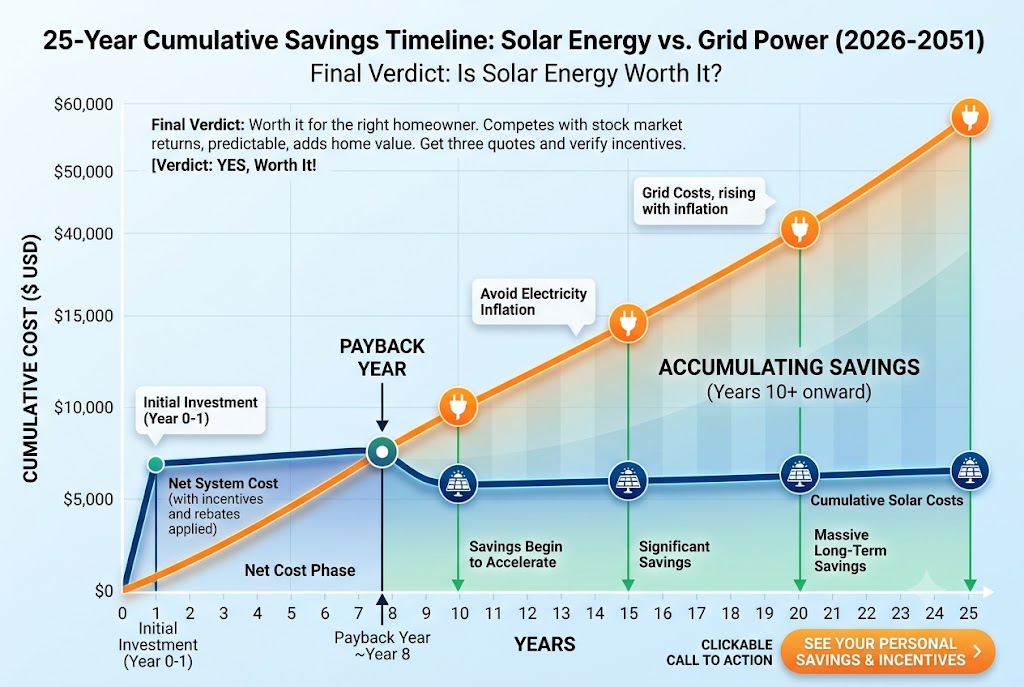
The average US payback period currently sits at around 7 to 9 years, and the average system lasts 25 to 30 years. That means most homeowners enjoy 15 to 20+ years of near-free electricity after breaking even — a return that beats most savings accounts and many investment alternatives.
But “worth it” depends entirely on your circumstances. Keep reading, because the devil is in the details.
What Does “Worth It” Really Mean?
This is where I always start with homeowners, because “worth it” means something different to everyone sitting across that table.
For some people, “worth it” means slashing the electricity bill as fast as possible. For others, it’s about long-term financial return — treating solar like an investment that compounds over decades. Some homeowners are primarily motivated by energy independence — the peace of mind that comes from not being entirely at the mercy of a utility company. And for an increasing number of people, environmental impact is the deciding factor.
Then there’s property value. Research from Zillow and Lawrence Berkeley National Laboratory consistently shows that homes with solar systems sell for a premium — typically 3% to 4% more than comparable non-solar homes, and sometimes significantly more in high-electricity-rate states.
Understanding your own priorities matters, because it shapes which factors to weigh most heavily when evaluating a quote. A homeowner who plans to sell in four years will analyze the decision very differently from someone who intends to retire in their current home.
Are Solar Panels a Good Investment?
Let me answer this the way a financial advisor would — because that’s essentially what this decision requires.
Long-Term ROI
A typical 7–8 kW residential solar system in the US costs roughly $21,000 to $26,000 before incentives. After the federal Investment Tax Credit (currently 30%), that comes down to approximately $14,700 to $18,200 for most homeowners. At average US electricity rates of around 16–18 cents per kWh — and with those rates having risen roughly 38% since 1990 — the math over 25 years is compelling.
Most homeowners who purchase outright can expect an annualized return of 8% to 12% on their solar investment, depending on location and electricity rates. That’s competitive with long-term stock market averages, but with one critical difference: solar returns are predictable. The sun isn’t subject to market crashes, recessions, or geopolitical shocks.
How Solar Compares to Other Investments
| Investment | Average Annual Return | Risk Level | Predictability |
|---|---|---|---|
| High-yield savings account | 4–5% | Very low | High |
| S&P 500 index fund (long-run average) | 8–10% | Medium-High | Low |
| Rooftop solar (owned outright) | 8–12% | Low | Very High |
| Real estate (average appreciation) | 4–6% | Medium | Medium |
Solar’s real edge isn’t just the return — it’s the risk-adjusted return. Your electricity savings don’t evaporate in a bear market.
A Real Homeowner Example
I worked with a couple in Sacramento last year. Their annual electricity spend was $2,900. They installed a 9 kW system for $24,000, claimed the 30% federal tax credit ($7,200), and their net cost was $16,800. Their annual savings came to approximately $2,600 (accounting for some remaining grid usage). Their payback period: 6.5 years. After that, they’re looking at 18+ years of near-free electricity — a lifetime return well over $40,000 on a $16,800 investment.
That’s not a marketing pitch. Those are real numbers from a real family who called me genuinely skeptical and ended up being some of the happiest solar customers I’ve worked with.
Is Solar Energy Cost Effective?
This is the second question I hear constantly — and it deserves a precise answer, not a vague “it depends.”
Upfront Costs
In 2026, the installed cost of a residential solar system in the US typically runs between $2.80 and $3.50 per watt. For a 7 kW system, that’s $19,600 to $24,500 before incentives. After the 30% federal ITC, you’re looking at roughly $13,700 to $17,150. Some states layer additional rebates on top, shortening the payback period further.
Always get at least three quotes. I’ve seen homeowners accept the first quote they receive and overpay by $4,000 to $6,000. The solar market is competitive — use that to your advantage.
Lifetime Energy Production
A well-sized system in a good location will produce roughly 1,000 to 1,400 kWh per kW of installed capacity per year, depending on climate. A 7 kW system in a sun-rich area like Texas or California might produce 9,800 to 11,200 kWh annually — enough to cover a significant household’s entire consumption.
Most quality panels degrade at about 0.5% per year, meaning your year-25 output is still around 88% of year-one capacity. That’s accounted for in manufacturers’ 25-year performance warranties, but it’s worth factoring into any long-run projections you’re given.
Electricity Inflation
This is the variable most homeowners underestimate. US electricity prices have risen at an average of 2.5% to 4% annually over the past 20 years. Every year that rate climbs, your solar system becomes more valuable — because the electricity it’s generating would otherwise cost you more to buy from the grid.
If your electricity rate is $0.17/kWh today and rises to $0.25/kWh over the life of your system, your effective savings per kWh increase significantly. This electricity inflation protection is one of solar’s most underrated financial benefits.
Maintenance Costs
Solar is genuinely low-maintenance — but it’s not zero-maintenance. Here’s an honest cost breakdown over a 25-year system life:
- Inverter replacement: String inverters typically last 10–15 years and cost $1,000 to $2,500 to replace. Microinverters generally last longer and come with 25-year warranties.
- Cleaning: In most climates, rainfall handles most of this. In very dusty areas (desert Southwest, for instance), occasional professional cleaning may help — budget $150 to $300 every year or two.
- Monitoring and occasional inspection: Most systems include monitoring apps. An annual inspection is good practice and typically costs $100 to $200.
Total expected maintenance cost over 25 years: $2,000 to $5,000 for most homeowners. That’s a fraction of the electricity savings.
The Five Factors That Determine Whether Solar Is Worth It
After hundreds of site assessments, I’ve narrowed it down to five things that actually determine the outcome. Everything else is secondary.
1. Your Electricity Usage
The more electricity you use, the more solar can save you. If your monthly bill is under $80, solar’s financial case is weak — the system will still generate power, but the payback period stretches out uncomfortably. If your bill is $180 or above, solar almost always makes strong financial sense.
Households with electric vehicles, swimming pools, or electric HVAC systems are particularly well-suited candidates, because their consumption is high enough to keep the ROI compelling even in less-than-ideal sun conditions.
2. Local Utility Rates
This is the single most important variable that most homeowners don’t know to ask about. If you’re in a state with high electricity rates — California, Massachusetts, Connecticut, New York, Hawaii — solar’s financial case is overwhelming. If you’re in a state with very cheap grid electricity — Louisiana, Oklahoma, parts of the rural Midwest — the economics are tighter.
Net metering policies also matter enormously here. Net metering determines how much your utility pays you for excess solar electricity you export to the grid. Strong net metering policies can dramatically improve your return; weak or unfavorable policies can undercut it. Always check your local utility’s current net metering rules before signing anything.
3. Roof Condition and Sun Exposure
A south-facing roof with an unobstructed view of the sky from 9 AM to 3 PM is ideal. East or west-facing roofs can still work well — typically producing 10–20% less than an optimal south-facing array, but often still financially viable.
Heavy shading from mature trees, nearby buildings, or dormers can significantly reduce output. I’ve walked away from recommending solar to homeowners whose trees would shade the roof for the better part of the day. No amount of good pricing overcomes poor sun access.
Also: if your roof is more than 15 years old, get a roof assessment before your solar quote. Installing panels on a roof that needs replacement in five years means paying to uninstall and reinstall them — an unnecessary expense of $1,500 to $3,000 that eats into your ROI.
4. Available Incentives and Rebates
The federal Investment Tax Credit at 30% is significant — but it’s not the only game in town. Many states offer additional tax credits, rebates through utilities, or property tax exemptions on solar installations. Some utilities offer rebates for solar paired with battery storage.
Here are some examples:
- California: Self-Generation Incentive Program (SGIP) rebates for battery storage
- New York: 25% state tax credit (up to $5,000) stacked on the federal credit
- Massachusetts: SMART program provides ongoing payments per kWh generated
- Texas: No state income tax credit, but property tax exemption on added home value from solar
The combination of federal and state incentives can cut your net cost by 40% to 50% in the most favorable states. Always check DSIRE (Database of State Incentives for Renewables & Efficiency) for your state’s current programs.
5. How Long You Plan to Stay in the Home
Solar’s financial return builds over time. In the first five to seven years, you’re in payback mode — your savings are accumulating toward breaking even on the installation cost. The real profit comes in years eight onward.
If you’re planning to sell within three to four years, solar may not benefit you financially — though it may increase your home’s sale price enough to recoup the investment. If you’re settling in for the long haul, solar is almost always worth it.
One nuance I’ve seen trip homeowners up: if you lease rather than own the panels, selling the home becomes more complicated because the new buyer needs to assume the lease. Owned systems transfer cleanly and add clear value. Leased systems can sometimes slow or complicate a sale.
When Solar Is Definitely Worth It
Based on my experience across hundreds of installations, solar makes the strongest financial and practical sense when:
- Your monthly electricity bill exceeds $150. The higher the bill, the faster the payback.
- You own an electric vehicle — or plan to buy one. Charging at home on solar power is essentially free and can dramatically improve the financial case.
- You have a pool or spa. These are electricity-hungry and running them on solar makes a meaningful dent in bills.
- You’re in a high-rate state — California, Massachusetts, New York, Connecticut, Hawaii, or similar.
- You plan to stay 10+ years. This is where the real wealth-building happens.
- Your roof faces south or southwest with minimal shading.
- You’re concerned about rising electricity costs. Solar is the most effective hedge against electricity inflation available to a homeowner.
I once helped a family in Connecticut with a $400/month electricity bill, a pool, and two EVs. Their 14 kW system paid back in under five years. By year ten, they’d saved over $30,000. That’s not unusual for high-consumption households in high-rate states.
When Solar May Not Be Worth It
This is the part that earns trust — because an honest solar consultant will tell you when the numbers don’t stack up.
Consider waiting or skipping if:
- You’re planning to move within three to five years. Unless you can clearly demonstrate a higher sale price that offsets the cost, the payback math doesn’t work in your favor.
- Your roof is heavily shaded. No amount of good equipment overcomes poor sun access. Ground-mount systems are an alternative if you have land, but they add installation cost.
- Your electricity bill is below $80/month. The savings simply aren’t large enough to justify the upfront investment in most cases.
- Your roof needs replacement within ten years. Do the roof first, then evaluate solar.
- Your utility has eliminated or severely curtailed net metering. Without fair compensation for exported power, the economics shift significantly. Always check current net metering policy before committing.
I told a homeowner in Seattle — with a heavily shaded north-facing roof and a $65/month electricity bill — that solar wasn’t a good fit for her situation. She thanked me, because three other companies had given her quotes without mentioning any of this. That’s the conversation every homeowner deserves.
The Hidden Benefits Most Homeowners Overlook
The financial return on solar is real and well-documented. But there are three benefits that don’t show up in payback-period spreadsheets that I’ve heard homeowners talk about again and again after installation.
Protection from rising energy prices. Once your system is installed, a significant portion of your electricity is effectively locked in at zero cost. When the utility raises rates — and they will — your insulation from those increases compounds in value over time. Homeowners who installed in 2016 and are now watching electricity prices spike are genuinely grateful.
Predictable monthly expenses. Instead of a bill that fluctuates with seasons, weather, and utility rate changes, solar gives you a more predictable monthly energy picture. For retirees and people on fixed incomes, that predictability has real psychological and budgeting value.
Behavioral engagement. This one surprised me when I first started noticing it. Homeowners with solar monitoring apps — which show real-time generation and consumption — become meaningfully more energy-aware. Many shift their laundry, dishwasher, and EV charging to peak solar hours, effectively amplifying their savings beyond what the panels alone deliver. The technology changes how people relate to their energy use, and that behavior change compounds over years.
Common Myths About Solar ROI
I hear these regularly. Let me address them directly.
Myth: “Solar pays for itself in two or three years.” Not in 2026 — not for most US homeowners. The realistic national average payback is 7 to 9 years. Anyone telling you two to three years without very specific justification (extremely high bills, significant state incentives, very low system cost) is overpromising. Manage your expectations around realistic numbers.
Myth: “You need a battery to make solar worthwhile.” Batteries add value — particularly for backup power and homes with poor net metering policies. But for most homeowners on a standard net metering tariff, a battery is optional. A grid-tied system without storage still delivers strong ROI. Add a battery if energy independence matters to you or your net metering terms make it worthwhile; don’t assume it’s essential.
Myth: “Solar will eliminate my electricity bill entirely.” Most grid-tied solar homeowners still receive a small monthly bill — often a fixed utility connection fee of $10 to $20, even with a zero-net-energy system. Unless you’re completely off-grid with significant battery storage, “elimination” is rarely accurate. “Dramatically reduced” is the honest framing.
Myth: “Every house should go solar.” Solar is excellent for a large proportion of US homes — but not all of them. Shaded roofs, very low electricity bills, planned short-term ownership, and poor local net metering policies can all make solar a poor fit. A genuine advisor tells you this. A salesperson often doesn’t.
Real Homeowner Scenarios
Scenario 1: The Nguyen Family — High Electricity Bills
The Nguyens are a family of five in suburban Dallas. Their average monthly electricity bill runs $280, driven by central air conditioning running most of the year, a swimming pool, and a growing household. They installed a 10 kW system for $28,000. After the 30% federal tax credit, net cost: $19,600.
Their annual savings on electricity: approximately $2,900 to $3,200 (accounting for remaining grid usage and their utility’s net metering credit). Estimated payback: 6.2 years. Over a 25-year system life, projected total savings: $55,000 to $65,000.
For the Nguyens, solar isn’t just worth it — it’s one of the best financial decisions they could make.
Scenario 2: The Retired Couple — Moderate ROI
Margaret and Robert are retired homeowners in suburban Ohio. Their electricity bill averages $130/month — moderate by US standards, and their state has average solar irradiance. They installed a 6 kW system for $18,000. After the federal credit: $12,600 net.
Their annual electricity savings: approximately $1,400. Payback period: 9 years. They have no plans to move and will likely remain in the home for another 15 to 20 years. Over that full period, their net financial benefit (savings minus system cost) is projected at $20,000 to $28,000.
It’s not as dramatic as the Nguyen family’s numbers. But for a couple on a fixed income who want predictable energy costs and a genuinely good return on a manageable upfront investment, it’s absolutely worth it.
Scenario 3: The Homeowner Planning to Move
James is a software engineer in Austin who bought his home two years ago and is fairly certain he’ll relocate for work within three to four years. His electricity bill runs $190/month and his roof is in good condition.
On paper, James looks like a solar candidate. But when we ran the numbers honestly, the picture was more complicated. A 9 kW system at net $17,500 after the tax credit would take approximately 7 years to break even on energy savings alone. He would recoup some value through increased home sale price — studies suggest solar adds 3% to 4% to home value, which on a $450,000 Austin home is $13,500 to $18,000. But that premium isn’t guaranteed, and it depends heavily on buyer perception in his specific market.
My honest advice to James: wait until you know you’re staying. Alternatively, look at whether a lease or PPA structure might make sense — though these come with their own trade-offs around long-term value and home sale complexity.
Not every homeowner should go solar right now. That’s a message more people in this industry need to be willing to say.
Frequently Asked Questions
For most homeowners with suitable roofs, moderate-to-high electricity bills, and plans to stay in their home for seven-plus years, yes. The combination of lower equipment costs, the 30% federal tax credit, and rising grid electricity prices makes the economics favorable for a large share of US homeowners.
Yes, generally. Owned solar systems typically deliver annualized returns of 8% to 12%, with far greater predictability than most market-based investments. The returns compound over a 25-year system life.
Over the lifetime of the system, almost always. The key is looking at the full 25-year picture rather than just the upfront cost. Per-kWh cost from a purchased solar system is typically well below the average retail grid rate.
The US national average payback period is currently 7 to 9 years. It can be as short as 4 to 6 years in high-electricity-rate states and as long as 12 to 15 years in states with very low grid rates or poor sun exposure.
Important: Never use harsh chemicals or abrasive sponges on your panels, as scratching the glass will permanently lower their output.
Most homeowners who purchase outright see an annualized ROI of 8% to 12%. Total lifetime return (savings minus system cost) often ranges from $20,000 to $65,000 or more depending on system size, location, and electricity rates.
Yes. Research from Zillow and Lawrence Berkeley National Laboratory shows solar homes sell for an average of 3% to 4% more than comparable non-solar homes. In high-rate states, that premium can be higher.
For most homeowners on a reasonable net metering tariff, yes. Batteries improve backup capability and may improve economics where net metering is poor, but they’re not essential for a strong financial return from a grid-tied solar system.
Final Verdict: Is Solar Energy Worth It?
After a decade of sitting across kitchen tables, running numbers, and following up with homeowners two, five, and ten years after installation — my honest answer is this:
For the right homeowner, solar is worth it more than almost any other home improvement investment available in 2026. It delivers financial returns that compete with the stock market, with far greater predictability. It protects against electricity inflation. It adds real value to your home. And the technology has matured enough that a well-installed system genuinely works as promised for decades.
But solar isn’t right for everyone. Heavily shaded roofs, very low electricity bills, short-term ownership plans, and poor local net metering policies are all legitimate reasons to pause. A good solar consultant will tell you which camp you’re in — and the ones who won’t tell you “no” when the numbers say no are the ones to walk away from.
Before you sign anything, get three quotes, check your utility’s current net metering policy, and verify your eligibility for federal and state incentives with a tax professional. And if you want to understand the broader picture of what solar energy offers — not just the financial return, but the full trade-offs involved — it’s worth reading a complete breakdown of the advantages and disadvantages of solar energy before making your final decision.
The numbers in 2026 are compelling. The technology is reliable. The question is whether your specific situation makes solar the right call. In most cases, it does.
Data references: EnergySage 2024 Marketplace Data; Lawrence Berkeley National Laboratory; Zillow Research; DSIRE (Database of State Incentives for Renewables & Efficiency); US Energy Information Administration; Lazard Levelized Cost of Energy 2024; SEIA Solar Market Insight Report.