
 Heating Solutions
 Solar Energy
When the chill sets in, you’re not looking for fancy marketing fluff—you want a space heater that genuinely works for your room, fits your budget, and keeps you comfortable. This detailed guide walks you through everything you need to know about oil-filled radiator heaters and ceramic space heaters so you can confidently choose the best one for your home without second-guessing yourself.
What is an Oil-Filled Radiator Heater?
An oil-filled space heater—also called an oil column heater—uses electricity to heat a sealed reservoir of diathermic oil. The oil flows through internal channels and metal fins, releasing warmth into the room through both radiation and convection. There’s no fuel to refill and no oil to replace—the oil is permanently sealed inside.
Inside, a resistive heating element gently warms the oil. That heat moves through the fins, radiating a slow, steady warmth. Thanks to its thermal mass, the heat lingers even after you turn it off, creating a stable, cozy atmosphere without sudden temperature changes. This makes oil-filled heaters ideal for bedrooms, living rooms, and home offices where you value quiet, consistent background warmth—especially for longer heating sessions like evenings or overnight use.
How an oil-filled heater works:
- A resistive element heats the sealed oil inside the body.
- The metal fins act like a radiator, releasing steady, even heat.
- The thermal mass keeps radiating warmth after switch-off.
Best for:
- Bedrooms, living rooms, and home offices needing quiet, consistent heat.
- Long heating periods (several hours or more).
What is a Ceramic Space Heater?
A ceramic heater uses a PTC (positive temperature coefficient) ceramic element that heats up rapidly when powered. Many models feature a built-in fan that pushes warm air into the room for quick, targeted heat. The PTC element is self-regulating—it draws more power when cooler and less as it heats up, which helps prevent overheating.
These heaters are perfect for instant comfort. Step into a cold room, switch one on, and you’ll feel warm within seconds. When you turn it off, the heat stops almost immediately, which helps avoid unnecessary energy waste. Ceramic space heaters are best for smaller rooms or situations where you want quick, focused heating rather than continuous all-day warmth.
How a ceramic space heater works:
- Electricity heats the ceramic plate(s).
- A fan (in most models) blows air over the heated element for fast warmth.
- Heat stops quickly after turning it off.
Best for:
- Small-to-medium rooms, spot heating, and quick warm-ups.
- Short sessions like working in a study or warming a bedroom before bed.
Oil-Filled vs Ceramic Heater: Side-by-Side Comparison
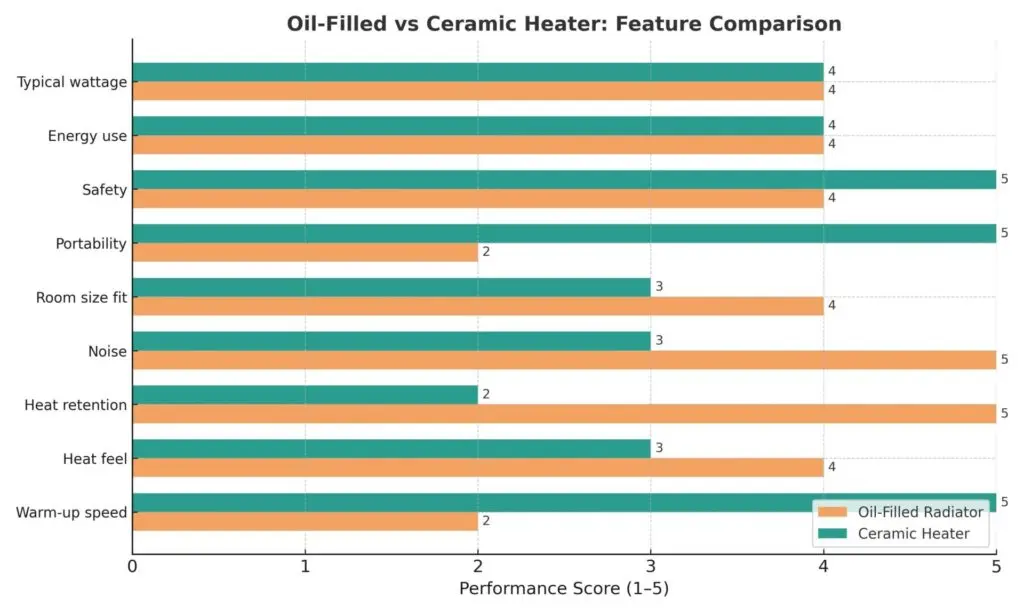
| Feature | Oil-Filled Radiator Heater | Ceramic Space Heater |
|---|---|---|
| Warm-up speed | Slow (10–30 min for full effect) | Very fast (warm air in seconds) |
| Heat feel | Gentle, even, ambient warmth | Focused, directional warmth |
| Heat retention | High—continues radiating after switch-off | Low—cools quickly |
| Noise | Virtually silent (no fan) | Low-to-moderate fan noise |
| Room size fit | Medium–large rooms; long sessions | Small–medium rooms; short use |
| Portability | Heavier; wheels help | Lightweight, easy to carry |
| Safety | Cooler surface than ceramic; still hot to touch | Often cool-touch housing with fan dispersion |
| Energy use | Efficient for long runs | Efficient for short bursts |
| Typical wattage | 1,000–2,400 W | 750–2,000 W |
| Best use case | “Set-and-forget” background heating | “On-demand” targeted heat |
Pros and Cons of Oil-Filled Heaters
Pros:
- Whisper-quiet—perfect for bedrooms and workspaces.
- Steady, even warmth without temperature swings.
- Keeps heating after switch-off thanks to thermal mass.
- Minimal dust circulation (no fan).
- Typically longer-lasting than fan-based heaters—no motor or fan bearing to wear out over years of use.
Cons:
- Slow warm-up time.
- Bulkier and heavier to move.
- Exterior can get hot to touch.
- Less efficient for quick heating needs.
Pros and Cons of Ceramic Heaters
Pros:
- Instant heat in seconds.
- Compact and easy to move.
- Often includes features like oscillation and ECO mode.
- Many models have cool-touch designs and strong safety features.
Cons:
- Fan noise (low to moderate).
- Loses heat quickly after shut-off.
- Less cost-efficient for continuous heating.
A note on air quality: Fan-forced heaters like ceramic units don’t remove moisture from the air, but by warming it quickly they lower relative humidity, which is what makes a room feel drier and can leave skin, eyes, or sinuses feeling parched after long sessions. Oil-filled heaters warm the room more gradually through radiant and passive convective heat, so most people notice less of this effect. If you run a ceramic heater for extended periods, pairing it with a small humidifier — or simply keeping sessions shorter — helps offset the dryness.
Energy Efficiency and Running Costs
All portable electric heaters turn almost 100% of the electricity they use into heat. The difference comes down to usage patterns—long runs vs. short bursts—and features like thermostats, ECO mode, and timers.
Example cost (Australia): Electricity rate: $0.30/kWh
- 2,000 W heater per hour: $0.60
- 4 hours in the evening: $2.40
Same wattage, same cost—the real difference is runtime
Here’s the part that surprises most people: a 2,000W oil-filled heater and a 2,000W ceramic heater cost exactly the same to run per hour, because cost is driven by wattage, not heater type. The savings come from how each heater is typically used.
| Scenario | Heater | Wattage | Runtime | Cost @ $0.30/kWh |
|---|---|---|---|---|
| Background heat, whole evening | Oil-filled | 2,000W | 6 hrs | $3.60 |
| Spot heat, on-and-off | Ceramic | 1,500W | 6 hrs (cycling) | ~$2.00–2.70* |
| Quick warm-up only | Ceramic | 1,500W | 45 min | $0.34 |
*Ceramic units cycle on and off more with the room thermostat since they heat and cool fast, so real-world draw is often lower than the rated wattage suggests over a full session.
The takeaway: if you’re heating a room for hours at a time, oil-filled’s thermal mass means it can coast on residual heat and cycle less. If you only need heat in short bursts, ceramic’s fast on/off response avoids paying to heat a room nobody’s using. Running the wrong type for your habit—e.g. leaving a ceramic heater on all evening, or using oil-filled for five-minute top-ups—is where people overspend, not the heater technology itself.
Tips to lower heating costs:
- Set thermostat to 18–20°C.
- Pre-warm with ceramic, maintain with oil-filled.
- Close doors, block drafts, use zoned heating.
- Use timers to prevent overrun.
What Size Heater Do You Need?
A heater that’s too small will run flat-out and still leave you cold; too large, and you’re wasting energy heating air the room doesn’t need. The standard rule of thumb, consistent with U.S. Department of Energy and major heater manufacturer guidance, is 10 watts per square foot (roughly 100 watts per m²) for a reasonably insulated room with standard ceiling height.
| Room size | Recommended wattage | Better fit |
|---|---|---|
| Up to 5 m² (bathroom, small study) | 500–750W | Ceramic |
| 10–15 m² (bedroom, home office) | 1,000–1,500W | Either, depending on session length |
| 15–25 m² (living room) | 1,500–2,000W | Oil-filled for long sessions |
| 25 m²+ / poor insulation | 2,000–2,400W, or two heaters | Oil-filled, zoned |
Adjust upward by around 25% for high ceilings, poor insulation, or older homes with single-glazed windows—the same room can need noticeably more wattage in a draughty period build than a modern, well-insulated one.
Important Features to Look For
When choosing the best oil-filled radiator or ceramic space heater, the right features can make all the difference in comfort, efficiency, and peace of mind. A digital thermostat is a smart pick, as it keeps your room at a consistent temperature without constant adjustments. Having multiple power settings gives you the flexibility to fine-tune heat output to suit the size of your space or your energy-saving goals.
Safety should always come first, so look for essentials like a tip-over switch, overheat protection, and a thermal fuse to help prevent accidents. If you’re leaning towards an oil-filled heater, more fins mean better heat distribution and more even warmth throughout the room.
For ceramic heaters, oscillation and fan speed control can direct warmth exactly where you need it. Added touches like a remote control, programmable timers, and child lock make everyday use more convenient, while smart features—such as app control, live temperature readouts, and energy tracking—put you in complete control of your comfort.
- Thermostat type: Digital holds temperature more accurately.
- Power settings: Multiple wattage levels for flexibility.
- Safety features: Tip-over switch, overheat protection, thermal fuse.
- Heat distribution (oil-filled): More fins improve convection.
- Air delivery (ceramic): Oscillation and fan speed control.
- Convenience: Remote control, programmable timers, child lock.
- Smart options: App control, temperature readout, energy tracking.
Safe Setup and Use
No matter which type of space heater you choose—oil-filled radiator or ceramic—it’s essential to use it safely to protect your home and loved ones.
Space heaters aren’t a minor safety category to skim past. In the US, the National Fire Protection Association reports heating equipment causes tens of thousands of home fires a year, and portable space heaters specifically are linked to an estimated 1,700 fires, 80 deaths, and 160 injuries annually according to CPSC data—with unattended units and heaters placed too close to flammable materials responsible for a disproportionate share of the damage. The safety habits below aren’t box-ticking; they’re the difference between a cosy room and a preventable house fire.
Always position your heater at least one metre away from curtains, bedding, furniture, or anything flammable to prevent accidents. Place it on a flat, stable surface so it can operate without risk of tipping over, and make sure the airflow isn’t blocked.
For safety, plug your heater directly into a wall outlet rather than using an extension cord or power board, which can overheat. Keep heaters well away from water unless they’re specifically rated for bathroom use, and never drape clothing or blankets over the unit. Finally, avoid leaving your heater running unattended—especially if children or pets are around—so you can enjoy warm, comfortable spaces with complete peace of mind.
- Keep at least 1 metre from curtains, bedding, and flammable materials.
- Use a flat, stable surface—avoid blocking airflow.
- Plug directly into a wall outlet, never into an extension cord.
- Never use near water unless bathroom-rated.
- Don’t cover the unit or leave it running unattended.
Popular Heater Models
Oil-Filled Radiators:
- De’Longhi Dragon series – Deep fins, strong convection, great for large rooms.
- De’Longhi Radia S – Sleek and versatile.
- Dimplex oil column heaters – Safe, timer-equipped models.
- Rinnai oil column heaters – Reliable and widely available in Australia.
Ceramic Heaters:
- De’Longhi HFX series – Fast heat, oscillation, ECO mode.
- Vornado ceramic heaters – Even airflow.
- Lasko ceramic heaters – Affordable, compact.
- Russell Hobbs compact heaters – Ultra-portable personal heaters.
Which Heater is Best for You?
Choosing the right heater really depends on your space and how you like to stay warm. If you want quiet, consistent warmth that gently fills a room—especially for longer sessions—an oil-filled radiator heater is your best bet. It’s perfect for bedrooms or medium-sized living rooms where steady, even heat matters most. But if you need instant comfort and fast, targeted heat—like warming up a chilly study in just seconds—a ceramic space heater will do the job beautifully. Both types have their strengths, so thinking about your room size and how quickly you want heat will help you pick the ideal heater for your needs without wasting energy or money.
- For quiet, consistent warmth: Choose an oil-filled radiator.
- For instant comfort: Go for a ceramic space heater.
- For medium living rooms: Oil-filled gives stable, even heat.
- For a cold study: Ceramic warms you up in seconds.
Answer these three questions to find your match:
- How long will it run per session? Under 30 minutes → ceramic. Several hours or overnight → oil-filled.
- How big is the room? Under 15 m² → either works. Over 15 m², especially with high ceilings → oil-filled, or a higher-wattage ceramic with oscillation.
- What matters more, silence or speed? Need it dead quiet for sleep or work calls → oil-filled. Need heat right now → ceramic.
Most households end up owning one of each—oil-filled for the bedroom or evening lounge session, ceramic for quick top-ups in a bathroom or home office.
FAQ – Oil-Filled vs Ceramic Heater
Yes, for long sessions—their thermal mass keeps radiating heat after switch-off. Ceramic is better for short, targeted heating.
A mild smell on first use is normal and fades quickly. The oil is sealed for life, so there’s nothing to top up or leak.
Most have tip-over and overheat protection, which helps. Still, never leave any heater running unattended, especially with kids or pets around.
Oil-filled heaters are silent, with no fan. Ceramic heaters use a fan, so expect a low hum.
Only if the model has a bathroom-rated IP rating—check the spec sheet first. Standard units aren’t built for splash or humidity exposure.
About 100W per m², adjusted upward around 25% for high ceilings or poor insulation.
Yes, noticeably—fast fan-blown heat lowers relative humidity faster. Oil-filled heaters warm more gradually, so the air feels less dry.
Oil-filled heaters typically last longer, since there’s no fan motor to wear out. Ceramic units are still durable but the fan is usually the first part to fail.
Final Thoughts – Choosing the Right Space Heater
If you want whisper-quiet heating for long, cozy evenings, an oil-filled radiator heater is your best bet. If you prefer fast, portable warmth on demand, a ceramic space heater will serve you well.
To get a tailored recommendation, share your room size, insulation quality, and heating habits, and you’ll have the perfect match—without wasting heat, energy, or money.