
 Heating Solutions
 Solar Energy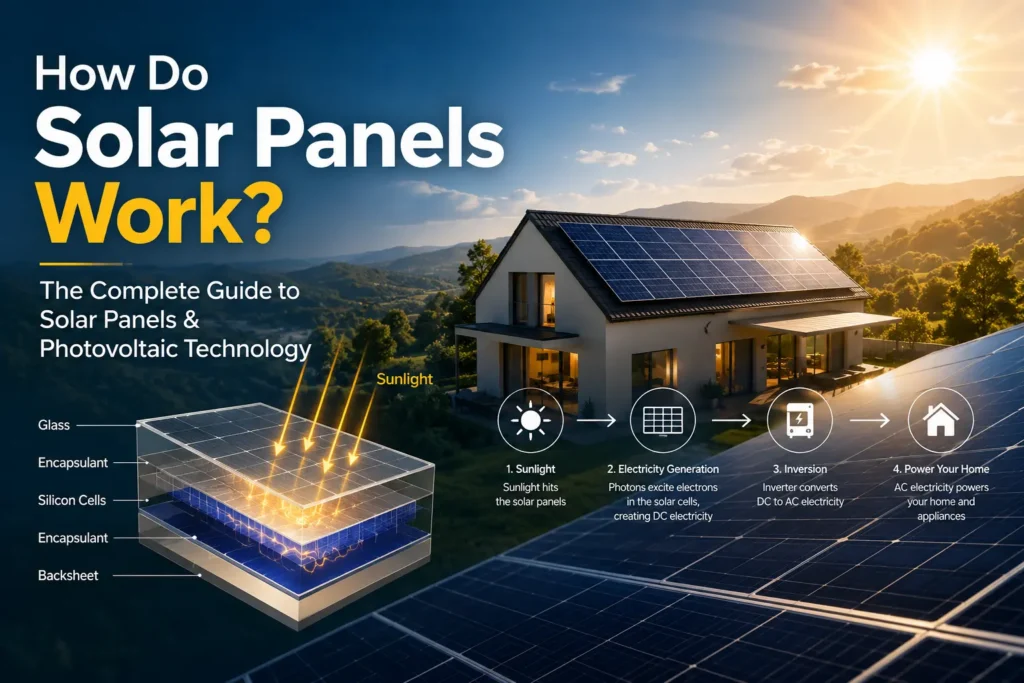
You’ve probably looked up at a rooftop covered in dark, glinting panels and wondered what’s actually happening inside them. It doesn’t feel like magic, but it’s close — sunlight goes in, electricity comes out, and no moving parts, no combustion, no noise. So how does a solar panel work, exactly?
The short answer is: physics, silicon, and a phenomenon discovered in the 1800s. The long answer is what this guide is for.
We’ll walk you through everything — from the atom-level behaviour of silicon to how your house actually uses the electricity a solar panel generates. Whether you’re a homeowner weighing up a solar installation, a student researching renewable energy, or just someone curious about one of the most consequential technologies of our time, this is the guide you need.
Why Solar Panels Matter Right Now
Before we get into the mechanics, it’s worth understanding the scale of what’s happening. According to the International Energy Agency (IEA), solar PV capacity additions in 2025 surpassed 600 GW for the first time in a single year, bringing cumulative global solar PV capacity to around 2,800 GW — making it the technology with the largest installed capacity of any energy source on the planet.
That’s not just impressive. It’s a fundamental shift in how the world generates power. The IEA projects that solar PV will account for nearly 80% of all new global renewable capacity through to 2030.
The reason solar has grown so explosively comes down to one thing above all else: the underlying technology works remarkably well, keeps getting cheaper, and is now accessible to ordinary households in most parts of the world.
So, how does it actually work?
The Foundation: What Is the Photovoltaic Effect?
Everything about solar panels begins with a discovery made in 1839 by a 19-year-old French physicist named Edmond Becquerel. He noticed that certain materials produced a small electric current when exposed to light. He called it the photovoltaic effect — “photo” from the Greek for light, “voltaic” from the electrical pioneer Alessandro Volta.
For over a century, it remained a scientific curiosity. Then, in 1954, researchers at Bell Labs produced the first practical silicon solar cell, achieving about 6% efficiency. Today, commercial panels routinely achieve 20–23%, and laboratory tandem cells have reached 34.85% under standard conditions and beyond 47% under concentrated sunlight.
The photovoltaic effect is the entire engine of how solar panels generate electricity. Everything else — the silicon, the wiring, the inverter — exists to harness and deliver it.
Inside a Solar Cell: The Role of Silicon
To understand how solar photovoltaic cells work, you need to understand silicon — and specifically, what happens when you engineer it very carefully.
Silicon is a semiconductor. That means it sits between conductors (like copper, which lets electricity flow freely) and insulators (like rubber, which block it). Under the right conditions, silicon can be coaxed into conducting electricity — and that’s exactly what solar cells exploit.
The Atomic Structure That Makes It Possible
Each silicon atom has 14 electrons. The outermost four — called valence electrons — are the ones that matter for solar energy. In a pure silicon crystal, each atom shares its four outer electrons with its four neighbouring atoms, forming a tightly bonded lattice. There’s no free movement, so no current flows.
A single gram of silicon contains roughly 21.4 quadrillion atoms. That’s an almost inconceivable number of valence electrons — and when the right conditions are met, some of them become free to move.
Doping: Creating the Electric Field
On their own, silicon atoms are electrically neutral and balanced. To create a solar cell, manufacturers deliberately introduce impurities into the silicon — a process called doping.
- The bottom layer (P-type silicon) is doped with boron, which has only three valence electrons. This creates “holes” — gaps where an electron should be but isn’t. These holes behave like positive charges.
- The top layer (N-type silicon) is doped with phosphorus, which has five valence electrons — one more than silicon needs. This creates free electrons with a negative charge.
When the P-type and N-type layers are joined together, something important happens at the boundary — called the P-N junction. Electrons from the N-type side drift across to fill holes in the P-type side. This movement creates a zone where positive and negative charges separate, establishing a built-in electric field that acts like a one-way valve.
This electric field is the secret ingredient. Without it, the freed electrons would just wander randomly. With it, they’re pushed in a specific direction — and that directional movement of electrons is, by definition, an electrical current.
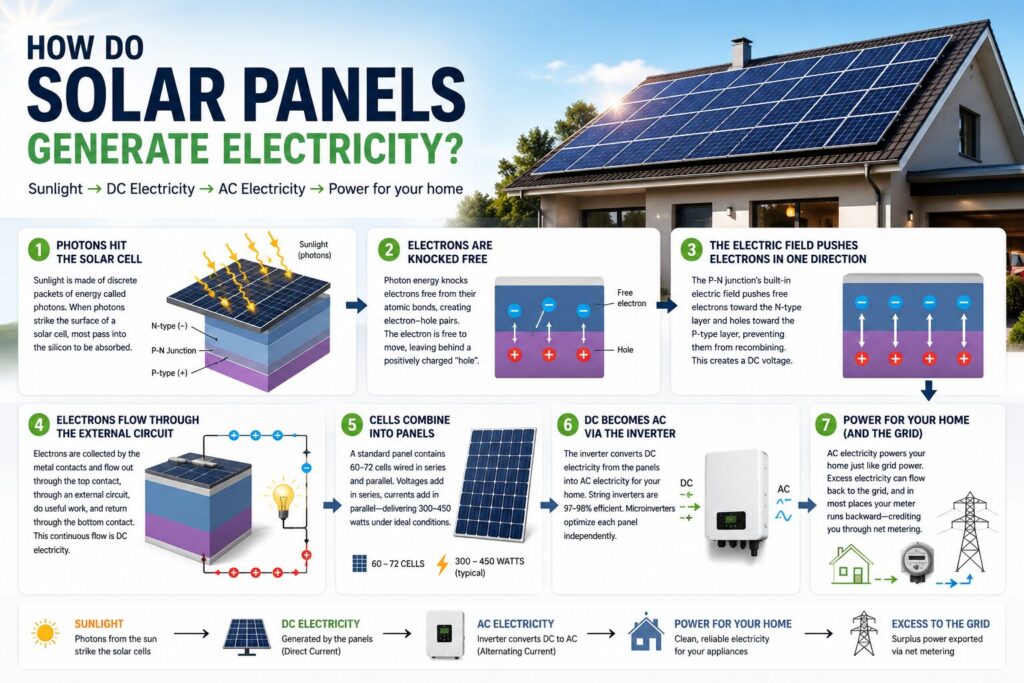
Step by Step: How Do Solar Panels Generate Electricity?
Now that you understand the structure, here’s exactly how a solar panel turns sunlight into the electricity that powers your home.
Step 1 — Photons Hit the Solar Cell
Sunlight isn’t a smooth stream. It arrives in discrete packets of energy called photons. When photons strike the surface of a solar cell, most pass into the silicon rather than reflecting off it (that’s partly why solar cells are dark in colour — they’re designed to absorb, not reflect).
Step 2 — Electrons Are Knocked Free
When a photon with enough energy strikes a valence electron in the silicon, it transfers that energy to the electron. This energy boost is sufficient to knock the electron out of its atomic bond, freeing it to move around. The atom it leaves behind now has a “hole” — a positively charged vacancy.
This creation of a free electron and a hole is called the generation of an electron-hole pair, and it’s the fundamental event that drives the entire process.
Step 3 — The Electric Field Pushes Electrons in One Direction
On their own, the freed electrons would move randomly and quickly recombine with holes, releasing their energy as heat — useless for generating electricity.
The P-N junction’s built-in electric field prevents this. It pushes free electrons toward the N-type layer and pushes holes toward the P-type layer. The electrons now have a preferred direction of travel, and that’s what creates a direct current (DC).
Step 4 — Electrons Flow Through the External Circuit
Metal contacts on the top and bottom of the solar cell collect the electrons. They flow out through the top contact, through an external circuit (your wiring), do useful work (powering your appliances), and return through the bottom contact. This continuous loop of electron movement is your solar electricity.
One solar cell typically produces around 0.5 to 0.6 volts — barely enough to charge a small LED. That’s why solar cells are wired together.
Step 5 — Cells Combine Into Panels
A standard residential solar panel contains 60 to 72 photovoltaic cells wired in series and parallel configurations. In series wiring, voltages add up; in parallel, currents add up. A typical panel produces 300–450 watts under ideal conditions — and an array of panels on a roof can produce kilowatts, enough to power a home.
Step 6 — DC Becomes AC via the Inverter
The electricity your panels produce is direct current (DC). Your home runs on alternating current (AC). A device called an inverter handles this conversion — either one central inverter for the whole array, or small microinverters on each individual panel.
Modern string inverters are around 97–98% efficient. Microinverters are slightly more expensive but allow each panel to perform independently, so shading on one panel doesn’t drag down the whole system.
Step 7 — Electricity Powers Your Home (and Potentially the Grid)
From the inverter, AC electricity flows to your home’s switchboard and behaves identically to grid electricity. Your appliances can’t tell the difference.
If your system produces more electricity than you’re using at that moment, the surplus flows back into the utility grid — and in most places, your meter runs backward, crediting you for the export. This is called net metering.
Types of Solar Panels: Not All Cells Are Created Equal
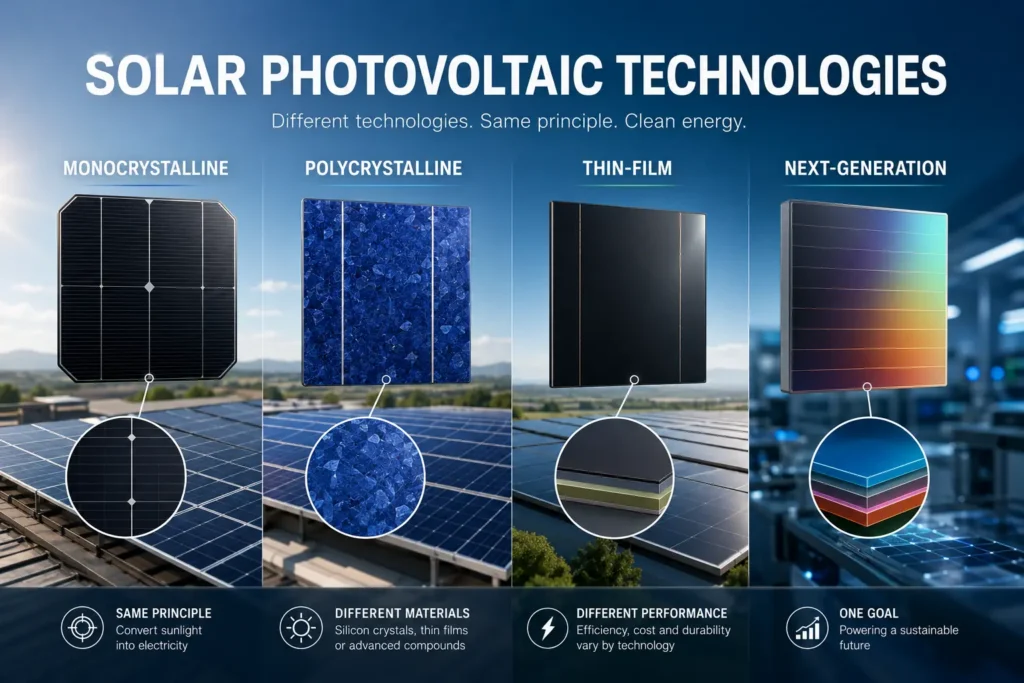
Understanding how solar photovoltaic cells work means knowing that different technologies use the same basic principles but achieve them in different ways.
Monocrystalline Silicon (Mono-Si)
Monocrystalline panels are made from a single continuous silicon crystal, grown using the Czochralski process — a slow, precise method that produces very pure silicon. The cells have a uniform dark colour and characteristic rounded corners (from the cylindrical ingot they’re cut from).
- Efficiency: 20–23% for commercial panels
- Degradation rate: as low as 0.25–0.3% per year for premium brands
- Best for: limited roof space where maximising output per square metre matters
Polycrystalline Silicon (Poly-Si)
Polycrystalline panels are made by melting silicon and pouring it into square moulds — faster and cheaper than monocrystalline production. The resulting cells have a speckled, blueish appearance because multiple silicon crystals grow in different orientations.
- Efficiency: 15–18% for commercial panels
- Degradation rate: around 0.5–0.6% per year
- Best for: larger installations where cost per watt matters more than space
Thin-Film Solar Cells
Thin-film panels use a completely different approach: a microscopically thin layer of photovoltaic material deposited on glass, plastic, or metal. Common materials include:
- Cadmium telluride (CdTe) — the most commercially successful thin-film type
- Copper indium gallium selenide (CIGS) — higher efficiency than CdTe
- Amorphous silicon (a-Si) — the original thin-film type, now less common
Thin-film panels are cheaper to manufacture and perform better in high-temperature and low-light conditions, but are generally less efficient (10–13%) and degrade somewhat faster. They dominate in large utility-scale installations and specialty applications like building-integrated PV.
Next-Generation Technologies
The cutting edge is moving fast. Perovskite-silicon tandem cells have reached 34.85% efficiency in laboratory settings and are on the cusp of commercial viability. Multi-junction cells used in space applications exceed 47% efficiency under concentrated sunlight. These aren’t yet on rooftops, but they define where the technology is heading.
What Actually Affects How Much Electricity a Solar Panel Produces?
This is where many guides fall short. Understanding how solar panels generate electricity is one thing; understanding the real-world variables that govern how much they actually produce is just as important — especially if you’re planning an installation.
Sunlight Intensity and Hours
Panels are rated at Standard Test Conditions (STC): 1,000 W/m² of irradiance, 25°C cell temperature. Real-world conditions are rarely this perfect. A panel rated at 400W might average 280–320W of actual output over a day, depending on your location.
Temperature — The Counter-Intuitive Factor
Here’s something most people don’t know: solar panels work less efficiently when they get hot. Silicon’s electrical properties degrade with heat. Panels are rated at 25°C, but a rooftop panel on a summer’s day can reach 50–70°C — or over 65°C in extreme climates like Australia’s inland regions.
The temperature coefficient — printed on every panel’s spec sheet — tells you exactly how much efficiency drops per degree Celsius above 25°C. A typical monocrystalline panel might have a temperature coefficient of -0.35% per °C. At 65°C (40°C above STC), that’s a 14% reduction in output.
This is why panels on cool, sunny days often outperform panels on hot summer days — even with more hours of daylight. It’s also why panels should be mounted with an air gap behind them for ventilation, and why selecting panels with a low temperature coefficient matters in hot climates like Queensland, California, or Spain.
“This catches a lot of homeowners off guard. Installers consistently report that customers expect their highest bills to drop most in summer — but the thermal efficiency loss means spring and autumn often deliver better bang for buck. A homeowner in Perth or Phoenix with a 6.6kW system might see their inverter reporting peak output on a crisp clear morning in September, not in the 40°C heat of January. If your monitoring app shows lower-than-expected output on hot days, the panels aren’t faulty — physics is just doing its thing.”
Shading
A shadow covering even a small portion of a solar panel can have a disproportionate impact on output — particularly in string-wired systems, where all cells in a series string are limited by the weakest-performing one. A single leaf, a TV antenna shadow, or a neighbouring building can meaningfully reduce generation.
Microinverters and DC optimisers (devices fitted to each panel) solve this by allowing each panel to operate independently. They’re worth the extra cost in most residential installations where some shading is unavoidable.
Orientation and Tilt
In the Southern Hemisphere, solar panels face north for maximum sun exposure; in the Northern Hemisphere, they face south. The optimal tilt angle roughly corresponds to your latitude — though in practice, rooftop angles are used as-is, since the losses from a non-ideal angle are usually small.
East- or west-facing installations work, but produce roughly 15–20% less than north/south-facing equivalents. They can, however, produce more electricity in the morning or afternoon — which may better match a household’s consumption patterns.
Soiling and Dust
Dirt, dust, bird droppings, and pollen accumulate on panels over time. In most climates, rainfall is enough to keep panels adequately clean. In arid regions — like parts of Australia, the Middle East, or inland California — soiling losses can reduce output by 5–25% between cleanings. This is a genuine and often underestimated factor in system performance.
“In practice, soiling is the most underestimated maintenance issue in residential solar. Installers in dusty inland areas — think the Riverina in NSW, or rural Queensland — often find customers who haven’t cleaned their panels in two or three years and have quietly lost 15–20% of their generation without realising it. A simple hose-down on a cool morning, two or three times a year, is usually all it takes. Don’t use high-pressure washers — they can damage the frame seals — and never clean panels when they’re hot, as the thermal shock can micro-crack cells.”
Solar Panel Lifespan and Degradation: What to Expect Over 25 Years
One of the most common questions about solar panels is: how long do they actually last?
The honest answer is that modern solar panels are extraordinarily durable. Most panels carry 25-year performance warranties guaranteeing they’ll still produce at least 80–85% of their rated output after a quarter century. And many panels from the 1980s and 90s are still functioning today, well beyond their rated lives.
What happens over time is gradual degradation — a slow, continuous decline in output. According to NREL research, the median degradation rate for modern commercial panels is around 0.5% per year. Premium panels from manufacturers using advanced cell technologies can achieve degradation rates as low as 0.25% per year.
To put that in concrete terms: a 400W panel degrading at 0.5% per year would still produce around 351W after 25 years — more than 87% of its original output.
Several factors accelerate degradation:
- UV exposure breaks down the EVA (ethylene vinyl acetate) encapsulant that protects cells
- Thermal cycling — daily heating and cooling — causes microscopic cracks in cell interconnections
- Potential-induced degradation (PID) — a phenomenon where voltage gradients cause ion migration, particularly in humid conditions
- Hot spots — areas of high heat caused by cell mismatch or partial shading — concentrate stress in localised areas
NREL climate-dependent analysis found degradation rates ranging from -0.5%/year in temperate climates to -0.88%/year in hot arid climates. That difference compounds to roughly a 9% lifetime output gap between panels installed in cool, overcast climates versus hot desert environments.
After the 25-year warranty period, most panels continue producing electricity — just at gradually declining efficiency. Many operators of commercial solar farms are extending system lifetimes to 30–35 years as economic analysis shows continued generation remains financially viable well beyond the warranty period.
The Anatomy of a Complete Solar System
Solar panels are one component of a larger system. Here’s what else is involved in a typical rooftop solar installation.
Solar Panels (PV Array): The panels themselves — anywhere from 6 panels for a small system to 30+ for a large home installation.
Inverter: Converts DC electricity from the panels to AC for use in the home. Modern hybrid inverters also manage battery storage.
Mounting System: Racking and rails that attach panels to the roof. Properly engineered mounting is critical — panels must withstand wind loads, and poor installation can compromise roof integrity.
Wiring and Combiner Boxes: DC cabling from panels to the inverter; AC wiring from the inverter to the switchboard.
Switchboard and Metering: Electricity flows from the inverter into the home’s main switchboard. A bi-directional meter measures both what you consume from the grid and what you export to it.
Battery Storage (Optional): A solar battery stores surplus daytime generation for use at night or during grid outages. Lithium-ion batteries (similar in chemistry to EV and phone batteries) now dominate the residential storage market. Common home batteries hold 10–15 kWh.
| Feature | Monocrystalline | Polycrystalline | Thin-Film |
|---|---|---|---|
| Efficiency | 20–23% | 15–18% | 10–13% |
| Appearance | Uniform black, rounded corners | Speckled blue, square cells | Uniform, often black or dark grey |
| Degradation Rate | 0.25–0.3% per year | 0.5–0.6% per year | 0.5–1% per year |
| Temperature Performance | Good | Moderate | Best |
| Space Required | Least | Moderate | Most |
| Lifespan | 25–30+ years | 25 years | 20–25 years |
| Cost | Highest | Mid-range | Lowest |
| Best For | Limited roof space | Budget installs | Large utility-scale projects |
Common Misconceptions About How Solar Panels Work
“Solar panels don’t work on cloudy days.” False — but they do produce less. Diffuse light still contains photons, and panels continue generating electricity on overcast days, typically at 10–25% of their rated capacity depending on cloud density.
“Heat makes solar panels more efficient.” The opposite is true. As explained above, high temperatures reduce silicon’s efficiency. Cool, bright days are ideal.
“Solar panels need direct sunlight to work.” Not strictly — they respond to light intensity rather than direct sun. But direct unobstructed sunlight produces significantly more than indirect or filtered light.
“Solar panels are not sustainable to produce.” The energy payback period for a modern silicon panel — the time to generate as much energy as was used to make it — is typically 1.5 to 3.5 years, depending on location and panel type. Over a 25-year lifespan, a panel generates 7 to 15 times more energy than it took to produce.
“One misconception worth adding from real installer feedback: many homeowners assume that a bigger system always means bigger savings. In practice, if you’re exporting most of your solar generation to the grid at a low feed-in tariff (as low as 5–8 cents/kWh in some Australian states right now), while buying back power at 30–35 cents/kWh at night, the maths changes significantly. The best-performing systems — in terms of return on investment — are typically sized to match daytime self-consumption, not maximum roof coverage. Battery storage changes that equation, but it’s worth understanding before you commit to a system size.”
A Note on the Physics: Why Not 100% Efficiency?
You might wonder: if sunlight has all that energy, why can’t a solar cell capture all of it?
The fundamental limit is called the Shockley-Queisser limit — a theoretical maximum efficiency of around 33% for a single-junction silicon solar cell. The reasons are:
- Photons with energy below silicon’s bandgap (1.1 eV) pass straight through without being absorbed
- Photons with energy above the bandgap are absorbed, but the excess energy above the bandgap is lost as heat
- Some recombination of electron-hole pairs is unavoidable
Multi-junction cells — used in space applications — get around this by stacking materials with different bandgaps, each capturing a different part of the solar spectrum. That’s how efficiencies above 40% become possible, though the manufacturing complexity and cost currently limit these to specialist applications.
The Future: Where Solar Panel Technology Is Heading
The technology is still improving rapidly. Key trends shaping the next decade:
Perovskite-silicon tandem cells are the most talked-about near-term development. Perovskite (a crystal structure first applied to PV in 2009) can be deposited cheaply on top of a conventional silicon cell, capturing parts of the spectrum that silicon misses. Lab efficiencies have already exceeded 34%, and commercial products are being developed by several manufacturers.
Bifacial panels capture sunlight from both sides — the front absorbs direct sunlight, while the rear captures reflected light from the ground or roof surface. This typically adds 5–15% to energy yield for minimal extra cost, and bifacial panels now make up a significant share of new utility-scale installations.
Building-integrated photovoltaics (BIPV) embed solar cells into roofing materials, glass facades, and windows — making entire buildings into power generators rather than just putting panels on top of them.
Heterojunction technology (HJT) combines crystalline silicon with thin layers of amorphous silicon, achieving very high efficiencies (24%+) and among the lowest degradation rates of any current commercial technology — often below 0.25% per year.
Putting It All Together
Let’s retrace the journey, start to finish.
The sun emits photons. Those photons travel 150 million kilometres to reach your roof. They hit the surface of a solar panel, penetrate the protective glass, and enter a layer of silicon that’s been deliberately engineered with a built-in electric field.
Inside the silicon, photons knock electrons loose from their atomic bonds. The electric field shoves those electrons in one direction — through metal contacts, out through your wiring, back around to complete the circuit. That flow of electrons is direct current electricity.
The inverter converts it to alternating current. Your switchboard distributes it to every socket and appliance in your home. If there’s surplus, it flows to the grid or into a battery. If there’s a shortfall — cloudy day, nighttime — you draw from the grid or battery instead.
All of this happens silently, continuously, with no moving parts, no fuel, no emissions at the point of generation.
The photovoltaic effect was discovered 185 years ago. It took another century to become practical. And now, in 2025, it’s the largest source of new electricity generation capacity being added to the global grid — nearly 80% of all new renewable energy capacity worldwide. What started in a French physics lab as a curiosity now powers hundreds of millions of homes.
And if you look up at those panels on your neighbour’s roof, you’ll know exactly what’s happening inside them.
Frequently Asked Questions
In most markets, residential solar systems pay back their cost through energy savings in 6–10 years, depending on system size, local electricity prices, available incentives, and how much of the solar generation you use directly.
No — without light, there are no photons to knock electrons free. Night-time electricity comes from battery storage (if installed) or the grid.
Yes, in principle. A well-sized system with battery storage can supply all of a household’s electricity needs. In practice, most grid-connected systems are sized to offset most (but not all) grid consumption.
Most panels are currently recycled — silicon, glass, aluminium, and copper can all be recovered. Dedicated solar panel recycling infrastructure is growing rapidly, particularly in Australia, Europe, and Japan, as the first large waves of panels reach end of life.
Important: Never use harsh chemicals or abrasive sponges on your panels, as scratching the glass will permanently lower their output.
Yes — particularly in traditional string-wired systems. Even partial shading on one panel can reduce output for an entire string. Microinverters and DC optimisers solve this problem by making each panel independent.
Data sources: International Energy Agency (IEA) Global Energy Review 2026; IEA Renewables 2025; NREL Spring 2025 Solar Industry Update; National Renewable Energy Laboratory degradation analysis; peer-reviewed research published in ScienceDirect and NCBI.